
Pantry Math: Stop Buying Groceries You Already Own
Every duplicate in your kitchen is sitting in the back third of a shelf. Shelf depth, pull-outs and zones, and when the cabinetry is the problem rather than your method.
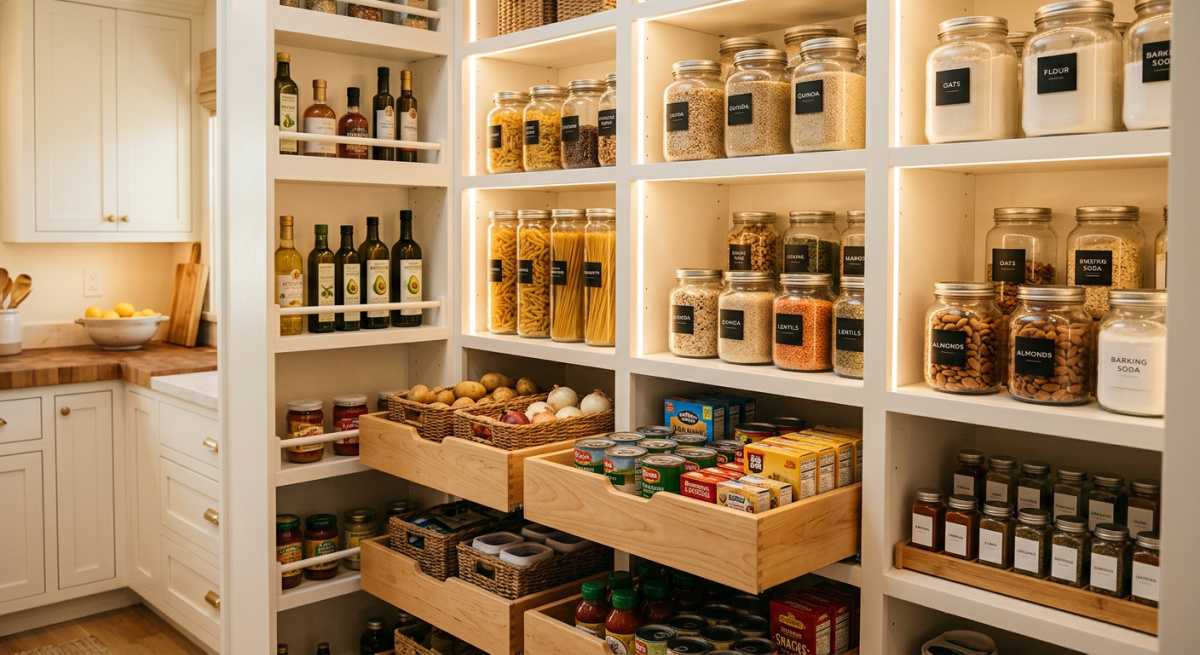
PULL-OUT STORAGE
Pull out shelves for kitchen cabinets are full-extension sliding shelves built to fit your exact cabinet openings, so you can reach the entire 24-inch depth of a standard base cabinet without crouching or unloading. Dream Spaces designs, builds and installs custom pull-out storage across the GTA and southern Ontario: one team, never subcontractors.
Yes. Pull-out shelves are the single highest-impact storage upgrade you can make without renovating. A full-extension pull-out brings everything in the cabinet out to you: no crouching, no flashlight, no unloading three things to reach the one you wanted.
The catch: the version worth having is built in. Drop-in wire racks rarely fit and rack sideways under load; a custom pull-out is measured to your cabinet and mounted on full-extension hardware rated for daily use: Blum, one of the major European hardware manufacturers, publishes that its hinge tests comprise 200,000 opening and closing cycles. Pull-outs are one piece of a larger custom kitchen storage plan and pair naturally with custom kitchen cabinets when you’re ready to change more than the interiors.
Here’s what a custom pull-out changes:
Every awkward cabinet has a purpose-built answer. Each solution below is chosen around what you store and how you cook, then built to the millimetre.
| Storage solution | What it solves | Where it works best |
|---|---|---|
| Full-extension pull-out shelves | Deep cabinets with unusable back halves | Base cabinets and lower pantry sections |
| Spice drawer inserts & pull-outs | Unreadable jars stored too close to the heat | Shallow drawers beside the range |
| Corner pull-out & swing-out systems | The blind corner every kitchen has | Corner base cabinets |
| Appliance garage | Counter clutter from daily-use appliances | Counter-level cabinetry in the work zone |
| Custom drawer dividers | Jumbled utensils, shifting trays, lost lids | Any drawer bank |
| Pull-out pantry columns | Tall cabinets and narrow gaps that swallow food | Full-height cabinets and slim fillers |
Two of these are big enough for their own pages: a pull-out pantry puts tall slide-out columns to work in spaces as slim as a broom cupboard, and custom pantry cabinets cover full built-in pantry walls from sketch to installation day.
A spice drawer organizer is a tiered insert that lays spice jars face-up at an angle in a shallow drawer, so you read every label at a glance, and spices stay below counter level, away from heat and light that fade them.
The difference between a drop-in tray and a built-in insert is fit: custom hardwood, made to your drawer and jar sizes, so nothing shifts or tips. Serious cooks often get a dedicated spice pull-out instead, a narrow cabinet beside the range.
A lazy Susan cabinet is a corner cabinet fitted with rotating shelves, so items in the dead corner spin around to meet you. It still earns its place, but round trays in a square cabinet waste space, and loose items can slip off the carousel into the void behind it.
A custom-built version fixes both: kidney or full-round trays shaped to the cabinet, raised edges that keep contents aboard, and hardware that turns smoothly under real weight. In many kitchens we skip the carousel for a swing-out corner system, more on that next.
The best corner cabinet solutions bring contents out instead of making you reach in: swing-out units that carry everything into the room, angled pull-outs that track around the bend, and corner drawers that open on the diagonal.
Swing-outs suit pots and heavy items used weekly; angled pull-outs work when the corner shares space with plumbing; corner drawers are the cleanest look in a new build. A decision a designer makes with a tape measure, not one to guess from a product listing.
An appliance garage is a counter-level cabinet with a lift-up or retractable door that keeps small appliances (coffee maker, toaster, blender) plugged in, hidden and ready. Close the door and the counter is clear.
Built into your cabinetry, an appliance garage disappears: the door matches the kitchen, the interior is sized to your machines, and outlets are planned inside the cabinet at the design stage. Why the built-in beats any add-on.
They do when they’re fixed and fitted. Custom drawer dividers are hardwood partitions built into the drawer box, sized around what lives in each drawer. Every item has a home it can’t drift out of. Plastic trays slide and gap; built-in dividers can’t.
The same thinking scales up: pegs that steady stacked plates in deep pot drawers, knife storage set flush so blades stay sharp, and vertical slots that stand baking sheets on edge.
It depends on scope, and we’d rather measure than guess. The main cost drivers: how many cabinets you’re outfitting, retrofit versus new cabinetry, hardware grade, and the insert materials and finish.
The starting point is a free design consultation: a designer looks at how your kitchen actually works and gives you an exact quote for your kitchen, not a bracket pulled from an internet average.
Usually, yes. If your cabinet boxes are square and sound, custom pull-out shelves can be built and installed inside the cabinetry you already own, no renovation required. A designer confirms fit at the free design consultation.
A drawer has fixed sides and its own front; a pull-out shelf is a sliding tray mounted inside a cabinet, behind the existing door. Drawers suit a new build; pull-outs are the smarter retrofit that keeps your kitchen’s current look.
You give up a little clearance to the runners, and gain usable access to the entire cabinet in return. The back half of a fixed-shelf base cabinet is dead storage in most kitchens; a full-extension pull-out puts it back to work.
Yes. Everything Dream Spaces builds is covered by a lifetime structural warranty: our own team designs, builds and installs every project, so one company stands behind the work.

Every duplicate in your kitchen is sitting in the back third of a shelf. Shelf depth, pull-outs and zones, and when the cabinetry is the problem rather than your method.

A chair needs three feet of floor behind it to stand up out of; a bench needs none. The dimensions that make built-in seating comfortable, and the tradeoff to know first.
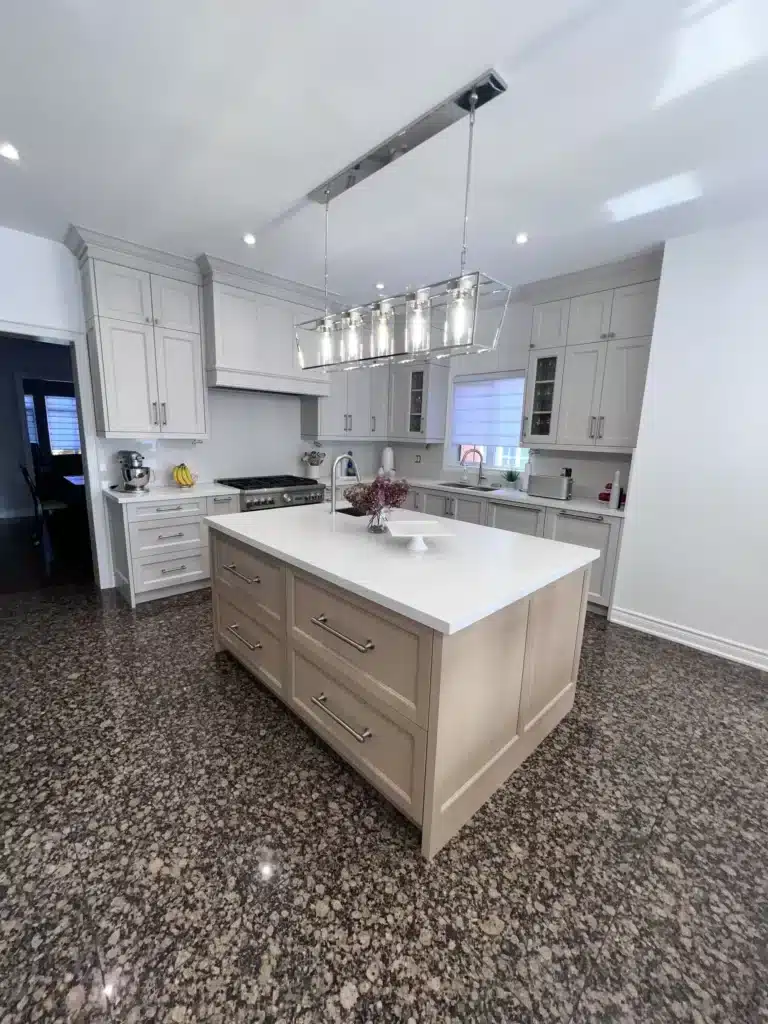
Most kitchens aren’t short of storage volume, they’re short of reachable storage. A walk through the blind corner, the deep base cabinet, the space above the fridge and the toe kick.
READY TO START?
Everything we build carries a lifetime structural warranty. Call 705-315-9169 or book a free design consultation. A designer comes to you.
"*" indicates required fields