Nearly every cabinetry quote you collect will have a warranty on it, and nearly every one of them will sound reassuring. Lifetime. Limited lifetime. Ten years on hardware. The words are doing a lot of work and the documents underneath them are wildly different from each other.
Reading one properly takes about five minutes and a few blunt questions. Here’s how to do it. We’ll use our own as the worked example, since it’s the one we can speak to honestly, but the method works on anybody’s paperwork, including the quote you’re about to compare ours against.
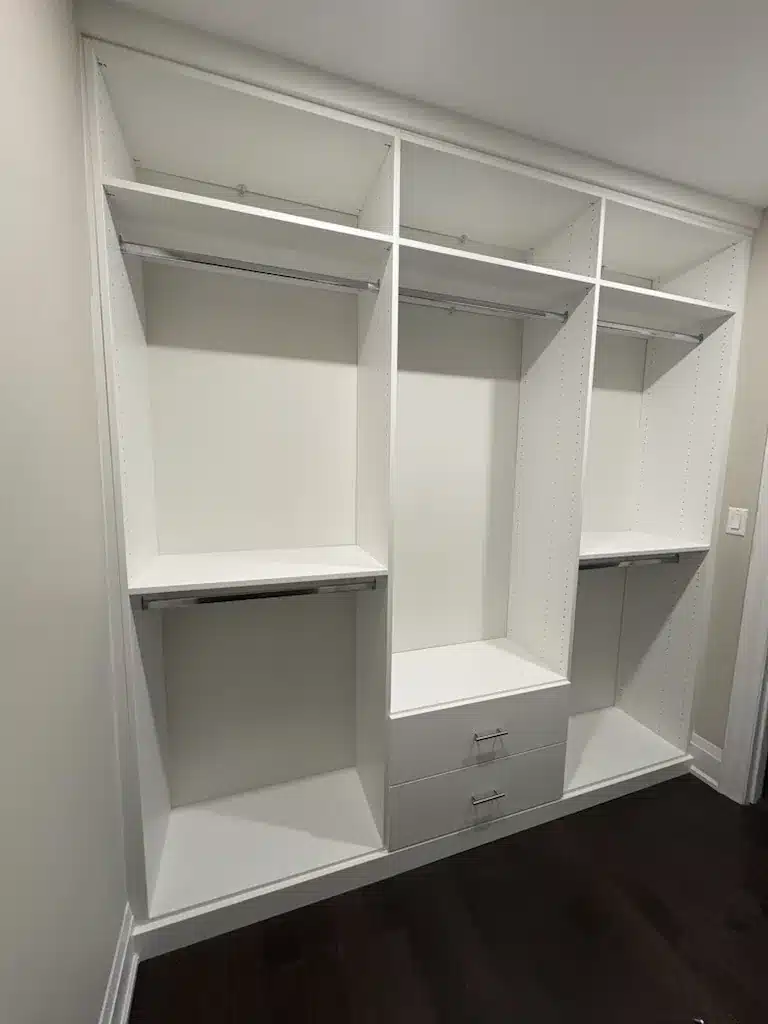
A reach-in that will be opened and closed a few thousand times a year. A warranty is a statement about what happens to this in year twelve.
What Cabinetry Warranties Usually Cover
Most warranties in this trade cover roughly the same territory, at least on paper.
Manufacturing defects is the core of it. A panel that delaminates, an edge band that lifts, a door that arrives out of true. These are failures of making, and any serious company stands behind them.
The finish is usually covered against peeling, bubbling or separating from the substrate under normal indoor conditions, though almost never against fading, scratching or the marks daily life leaves.
Hardware and moving parts are the pieces that actually wear, since a drawer slide or a hinge is a mechanism with a duty cycle. Sometimes hardware carries its own separate term, shorter than the cabinetry, and sometimes it’s covered by the hardware manufacturer rather than by the company you bought from. Worth knowing which.
Structural performance means shelves that don’t sag and boxes that don’t rack under normal loading. This is where board thickness quietly decides whether a warranty is easy or expensive to honour.
What They Usually Exclude
The exclusions are shorter to read and more likely to matter.
Normal wear is nearly always excluded, and reasonably so. Scratches, dents, the shine that develops where a hand touches a drawer front every morning. So is damage from misuse, and the definition of misuse is broader than people expect: overloading a shelf well past its rating, hanging off an open door, standing on a drawer to reach the top shelf.
Water damage is a common exclusion, and in a laundry room or a basement closet that’s not academic. Damage from someone else’s work is another, so if a contractor modifies your cabinetry, the modified section usually leaves the warranty with them. And most warranties exclude the natural variation in wood grain and colour, along with any change caused by a house being kept unusually dry or unusually humid.
Six Questions to Ask Before You Sign
Take these to any quote, including ours.
1. Does it include labour, or only the part?
This is the big one, and it separates warranties more than any other line. A parts-only warranty mails you a shelf. Somebody still has to remove a run of cabinetry, fit the replacement, scribe it to the wall and adjust the hardware, and if that labour isn’t covered, a covered defect can still arrive with an invoice attached.
2. Does it survive if I sell the house?
Ask whether it transfers to the next owner, and if so, whether anything has to be filed to make that happen. Non-transferable warranties are common and are not a scandal, but a transferable one is a genuine asset when you list.
3. Who honours it if a subcontractor did the install?
Plenty of installation problems look like manufacturing problems from a homeowner’s chair. A cabinet that’s out of level, a door that binds, a panel that pulls away from a wall. If the company built it and a subcontractor fitted it, you can end up standing between two businesses, each of them politely pointing at the other. Ask directly who is responsible for install faults and get the answer before you need it.
4. What voids it?
Read the list. Common items are moving the cabinetry to another wall or another house, refinishing it, modifying it, or fitting non-approved hardware. None of these are unreasonable. You just want to know before you decide to relocate a tower yourself.
5. How do I make a claim, and to whom?
A phone number for the company that built it is a very different experience from a form that goes to a distributor who contacts a manufacturer. Ask what the first step is and how long it usually takes.
6. Will the part still exist?
The quiet one. A warranty on a colour that gets discontinued and can’t be matched is a warranty on a mismatched shelf. Ask how long the board lines the company builds with have been in production.
The Part Most People Miss
Here’s the reframe worth carrying into every showroom conversation. A long warranty is a bet the company is placing on its own construction. The company is saying it expects this cabinetry to survive decades of daily use without generating enough claims to hurt.
Which means the warranty document is downstream of the materials. If you want to know whether a lifetime warranty is safe or theatrical, look at what the thing is built from and ask whether a company could sensibly offer that term on that construction. A generous warranty attached to thin board and cheap hardware is a marketing decision. The same warranty attached to heavy, stable material is an engineering one.
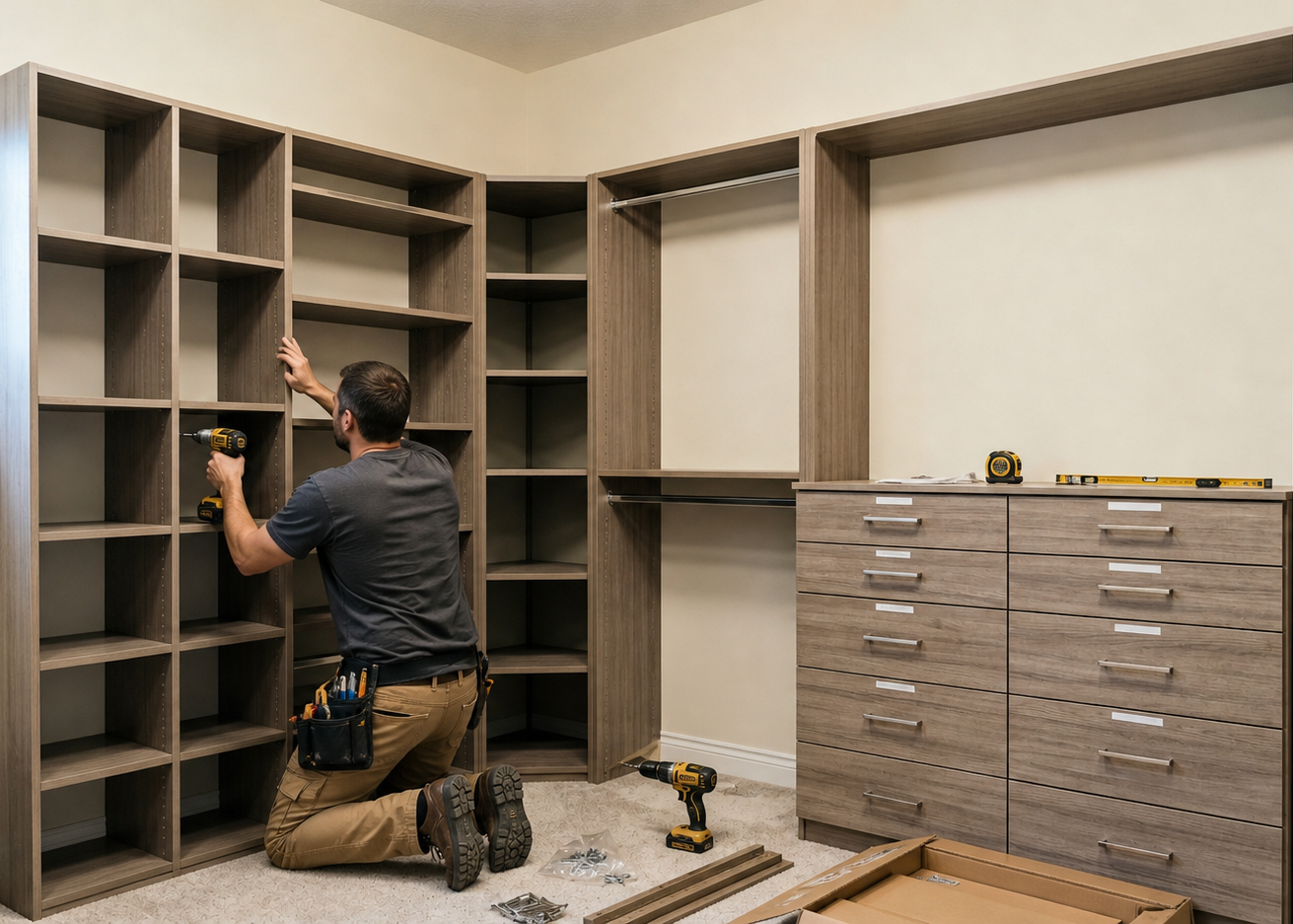
The crew fitting it and the company honouring the warranty are the same organization. That single fact is what makes a claim simple to make.
Why Board Thickness Changes the Bet
We build with 3/4″ thermally fused laminate, the thickness commercial specifications from AWMAC and AWI generally require, rather than the 5/8″ board many systems use to bring a quote down. That difference sounds cosmetic and isn’t.
Bending stiffness scales roughly with the cube of thickness, so over the same span, the thicker board is dramatically more rigid. That’s the difference between a shelf that still reads flat under a stack of sweaters in year ten and one that has taken a permanent smile. The thicker board also holds hinge and slide screws better, because there’s more material around each screw to resist the pulling and twisting a drawer applies every single day.
The second material property matters just as much. TFL is dimensionally stable in a way solid wood isn’t, so it doesn’t move much as a house swings from dry furnace air in February to humid air in August. Solid wood doors move with that cycle, which is why they need seasonal adjustment and why gaps change through the year. Stable panels stay true, so doors keep lining up and drawers keep closing the same way.
Put those together and a long warranty stops being a leap of faith. Rigid panels that don’t sag, screws that stay held, and doors that don’t move with the seasons produce very few of the claims that would make a lifetime term painful to offer. That’s the reasoning behind the Homeowners Lifetime Warranty on everything we build.
Who Fitted It Is Part of the Promise
The last variable isn’t in the document at all. A warranty from a company whose installers are its own employees is a different promise from one where nobody can quite say who fitted your cabinetry.
Most of what goes wrong in year two traces back to install day rather than to the shop. Levelling on an uneven floor, scribing to a wall that isn’t straight, fixing a tall unit properly so it stays put. Our installers are on our payroll, so the same company that made your cabinetry is accountable for how it was fitted, and there’s no second business to route a complaint through. You can see where installation sits in the full sequence on our custom cabinetry design, build and install process page.
Ask Us the Six Questions
We build custom storage across Ontario, and we’d rather you arrive at a design appointment with a list of hard questions than a vague good feeling. A designer comes to your home with the finish samples so you can see them in your own lighting and next to your own floors, and works through the layout with you in about ninety minutes. Kitchen projects get two ninety-minute appointments, the first covering the design and how you use the room, the second covering the finalized design with full pricing. Everything, including the custom closet systems we build across Ontario, is made in our Barrie workshop at 73 Saunders Rd, installed by our own employees rather than subcontractors, and covered by the Homeowners Lifetime Warranty. Book your in-home design appointment and bring the list.