Look at four cabinetry websites and you’ll find the same two words on all four. Canadian-made. Proudly Canadian. Made right here at home. It has become the kind of phrase that sounds like a fact and functions like a mood, and homeowners have started to notice that it appears on quotes that are otherwise nothing alike.
The phrase can still be useful, but only if you make it specific. There are four separate things a cabinet company can mean by it, and a company can honestly claim one of them while quietly not doing the other three. Here’s how to tell which version you’re buying, and why the difference shows up in your calendar and your warranty rather than in the brochure.
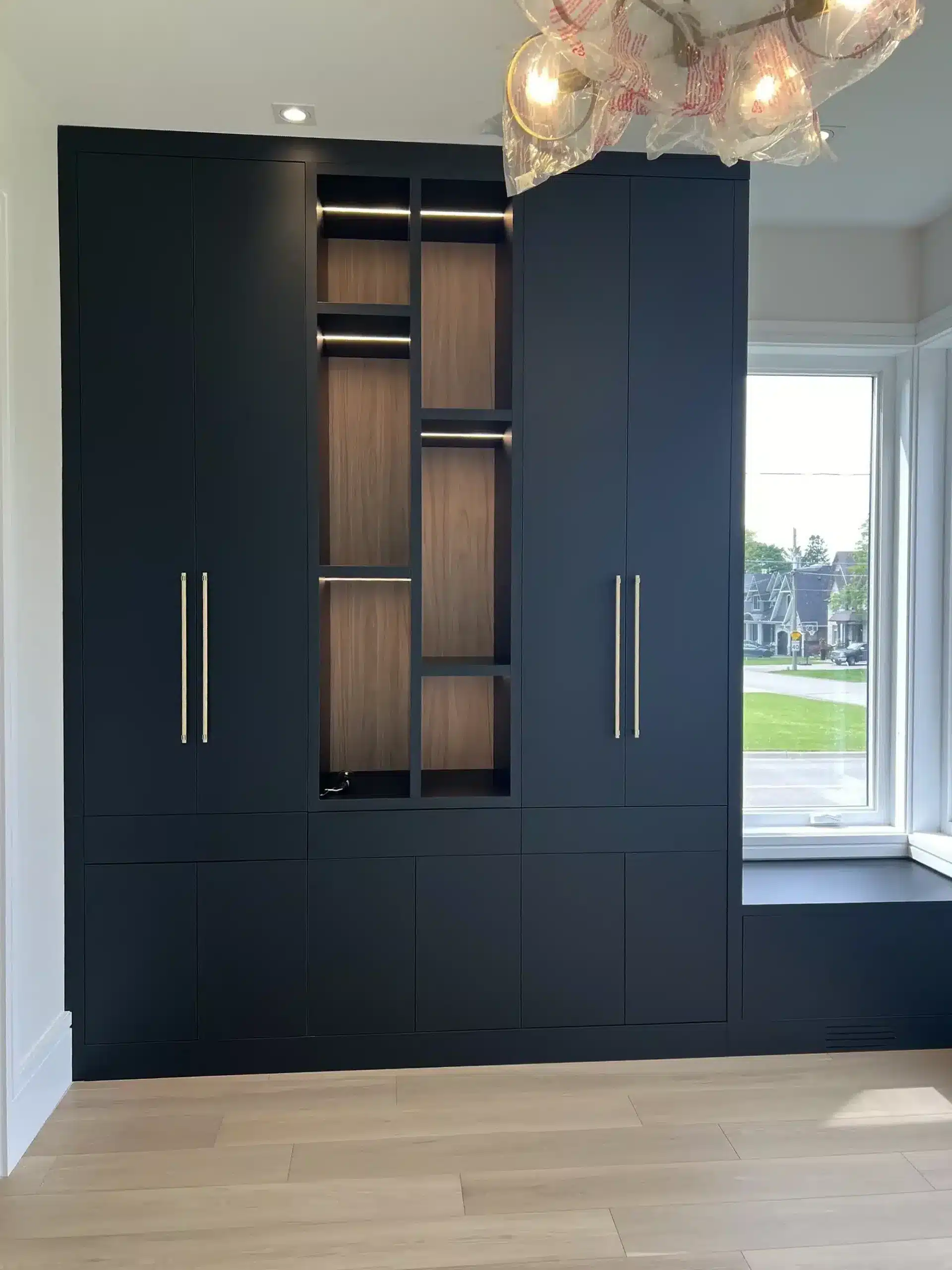
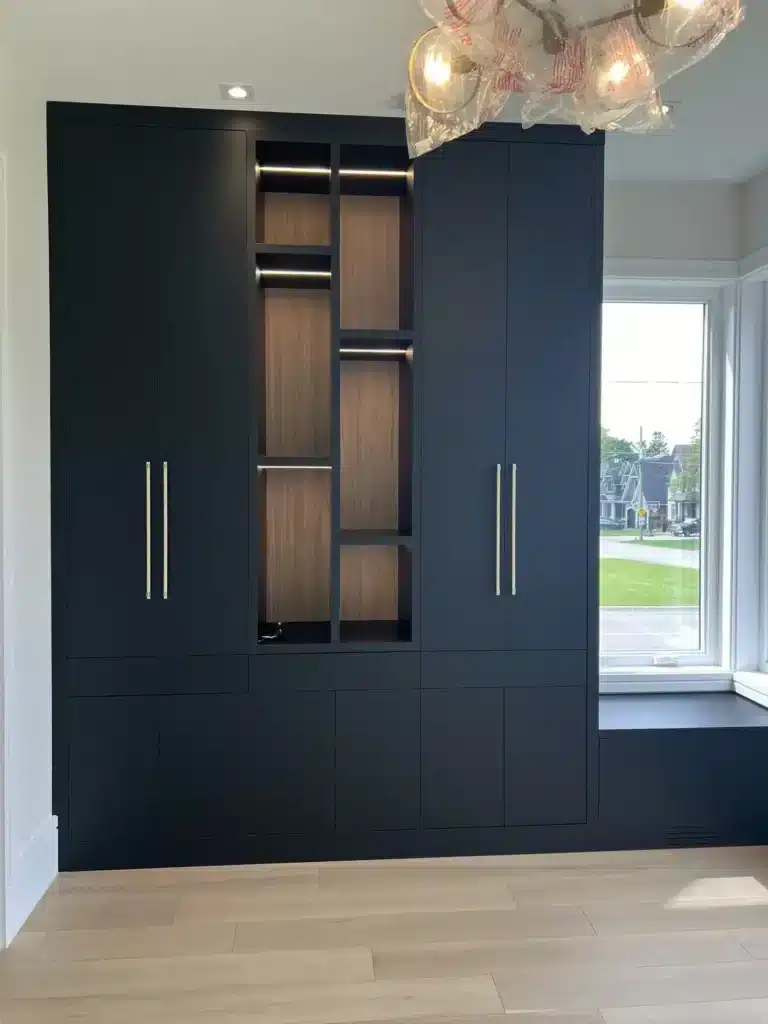
A wardrobe wall in navy with a lit walnut bay through the middle. The interesting question about any cabinetry like this is which parts of it were made where, and by whom.
Four Different Claims Hiding in One Phrase
Designed here. A person in Ontario drew your cabinetry for your walls, with your ceiling heights and your out-of-square corners in the file. This one is real and it matters, since design is where a project either fits your house or fits a catalogue.
The board was manufactured here. The panel stock itself was made in a Canadian plant. This is a supply chain claim about raw material, and it’s independent of who cuts it.
The boxes were built here. Panels were cut, bored and edge-banded in a shop in this country, to sizes taken off your walls. This is the claim most people assume they’re hearing.
The people who fit it work here. The crew in your hallway is on a Canadian payroll rather than assembled from whoever had an opening that week.
Four claims, and a company can be strong on one and weak on the rest. Nothing about the phrase itself tells you which.
What It Often Means Instead
Two softer versions come up a lot, and neither is illegal or even especially sneaky. They just aren’t what you probably heard.
The first is assembled here from imported flat-pack. Components are manufactured overseas in standard sizes, shipped in containers, and put together in a Canadian warehouse. Real work happens here, but the sizes were decided before anyone saw your room, and the parts come from a factory nobody involved in your project can phone.
The second is the office is here. Sales, design and admin sit in a Canadian city, and manufacturing happens somewhere else entirely. There’s nothing dishonest in it, but the claim is about where the invoices get written rather than where the sawdust lands.
The reason to care isn’t patriotic bookkeeping. It’s that the version you’re buying determines what happens the day something goes wrong, and something eventually does.
Four Questions That Sort It Out
You don’t need to interrogate anyone. Ask these plainly and pay as much attention to how easily they’re answered as to the answers.
1. Where is the shop, and can you name the street?
A company that manufactures somewhere specific will tell you the address without pausing. Ours is on Saunders Road in Barrie. A vague answer about “our manufacturing partners” is an answer.
2. Are my parts cut to my measurements, or picked from stock sizes?
This is the flat-pack question in polite form. Cut-to-measure means your out-of-square wall is handled in the shop. Stock sizes mean it gets handled with filler strips on install day.
3. Who makes the board itself?
A builder who buys from established manufacturers will name them. It’s a fair question and there’s no reason to dodge it.
4. Are the installers employees or subcontractors?
Ours are employees. That single fact decides who you call in year three and whether that person still has any relationship with the company that made your cabinetry.
Short Supply Chains Show Up as Short Lead Times
Here is the practical argument, and it has nothing to do with flags. Every border a component crosses is a place where your project can wait. Containers get delayed. Customs paperwork sits. A shipment gets held and nobody in your city can do anything about it except apologize on the phone.
Cabinetry made in Canada skips that whole category of risk, because the parts never leave the country. Lead times get shorter and, more usefully, they get predictable, which is the thing that actually matters when you’ve booked a painter and taken time off work.
The gap widens further when something has to be remade. A panel gets damaged in transit, or a wall turns out to be further out than the drawing suggested, or you change a drawer front at the last honest moment. When the shop is forty minutes from your house, that part gets recut and delivered inside the same job. When the part came from overseas, it gets reordered, and now your kitchen is missing a door for a period of time nobody can predict. We go into what we build and where on our Canadian-made custom cabinetry and storage page.

A fireplace wall built to the room’s actual dimensions. The stone, the reveal above the cabinets and the shelf heights all had to agree with each other.
A Warranty Is a Manufacturing Promise in Disguise
This is the part homeowners tend to work out only in retrospect. A long warranty on cabinetry is a promise that the company can still make your part years from now: the same board, the same colour, the same thickness, cut to match what’s already in your house.
That promise is easy to keep when the parts are cut in a building the company owns, from board lines that established manufacturers keep in production. It gets harder as the distance between the warranty and the saw grows. If the original components came from an overseas factory the company doesn’t control, year eight is a phone call about whether that product line still exists.
So when a warranty looks generous, look past the wording and ask where the replacement part would physically come from. That answer tells you more about the warranty than the warranty document does.
The Board We Build With
We build with 3/4″ thermally fused laminate, the thickness commercial specifications from AWMAC and AWI generally require, rather than the 5/8″ board many systems use to bring a number down. Bending stiffness scales roughly with the cube of thickness, so the thicker board is far more rigid over the same span and holds hinge and slide screws better over years of daily pulling.
The boards come from established manufacturers, many of them made in Canada. Our higher-end lines include Tafisa TFL, which is LEED certified and made with up to 50% recycled material. TFL is also dimensionally stable in a way solid wood is not, so doors and panels stay true through a Canadian winter of dry indoor air followed by an August of humidity. That stability is a large part of what makes a lifetime warranty realistic rather than optimistic.
Where the Work Happens
We build custom storage across Ontario, and the honest summary of our version of the phrase is short. The design is done in your home. The board is manufactured by established makers, much of it in Canada. The cutting, boring and edge-banding happen in our Barrie workshop at 73 Saunders Rd. The people who carry it into your house are on our payroll.
That last one is the accountability point. When the crew are employees, the person levelling your cabinets and the company honouring the warranty are the same organization, so nothing gets lost in the space between two businesses. Supporting a local manufacturer also keeps the work here, in a shop with people in it, which is the part of “Canadian-made” that was worth meaning in the first place.
See the Samples in Your Own Light
The easiest way to check any of this is to make a company come to you. A designer arrives with the finish samples so you can hold them in your own lighting and next to your own floors, and works through the layout with you in about ninety minutes. Kitchen projects get two ninety-minute appointments, the first for the design and how you use the room, the second for the finalized design with full pricing. Whether it’s custom kitchen cabinets built for Ontario homes or the custom closet systems we build across Ontario, it’s made in our Barrie workshop, installed by our own employees rather than subcontractors, and covered by the Homeowners Lifetime Warranty. Book your in-home design appointment and ask us the four questions.