Here’s a thing that happens every morning in most houses in Ontario and almost nobody names. You walk into the closet, reach for the rail, and the clothes go dark. That’s because the only light in the room is on the ceiling behind you, and you are now standing between the bulb and everything you own. You are choosing an outfit inside your own shadow.
Then you carry a shirt out to the window to check whether it’s navy or black, which is the most common closet-lighting complaint we hear and the easiest one to design out. Lighting is the most overlooked part of closet design and one of the cheapest to get right, provided the decision gets made before anything is built.
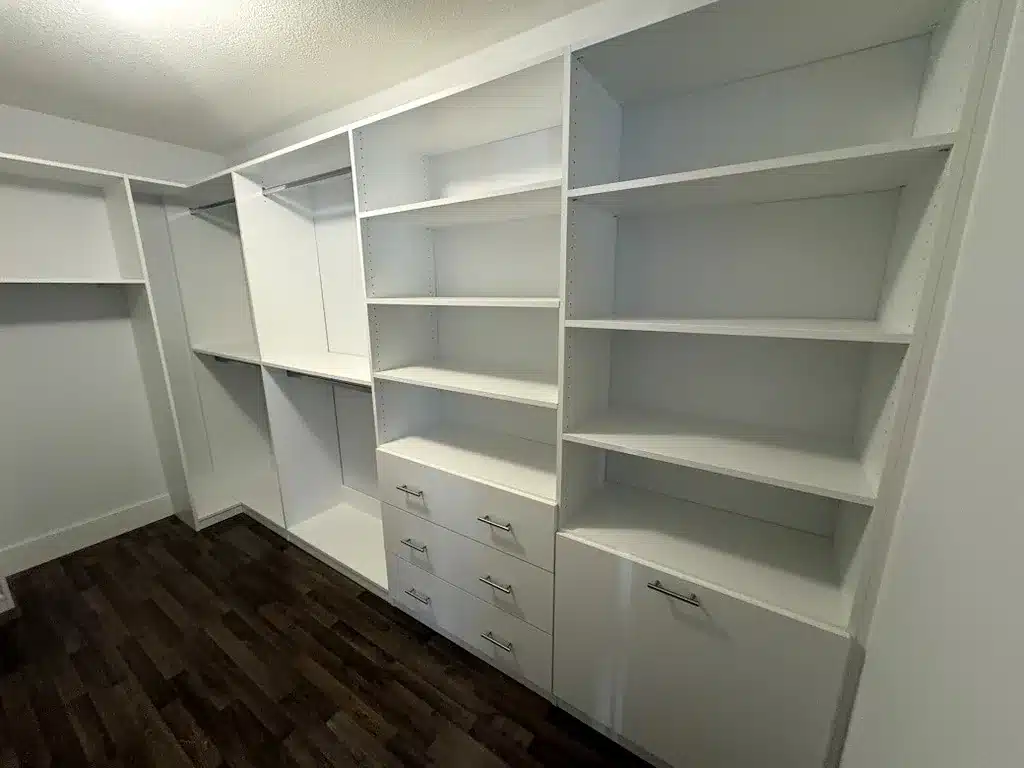
A shelf tower, a drawer bank and hanging on two walls. Every one of those bays wants its own light, and the fixture behind your head reaches none of them.
Why One Ceiling Fixture Fails at This Job
Two separate problems, and they compound.
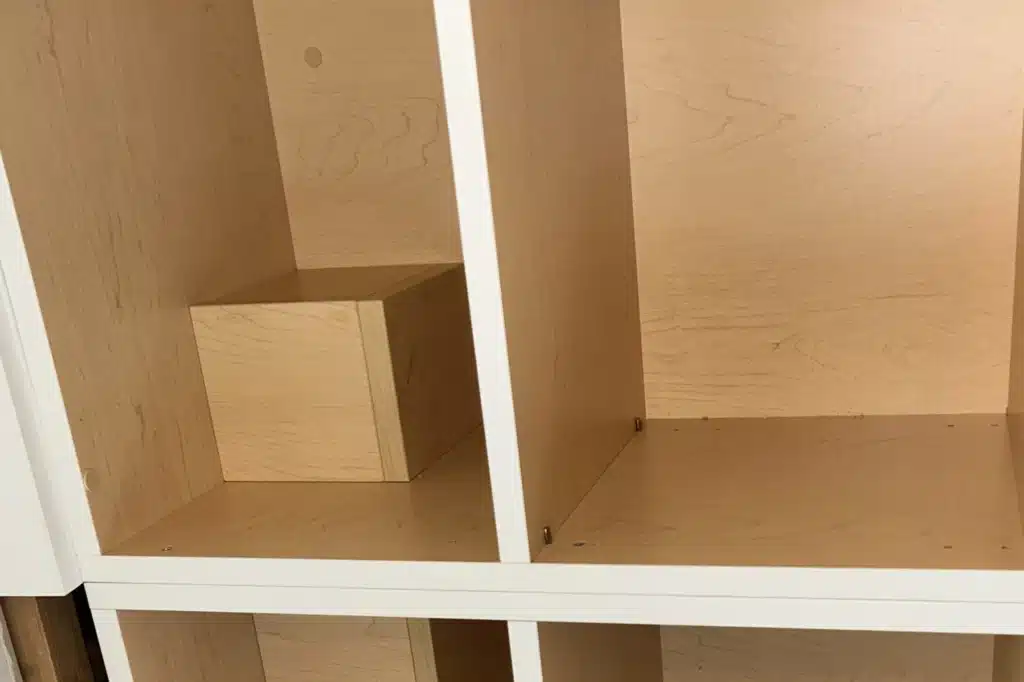
The first is geometry. A single fixture overhead throws light down the front face of a hanging section, so the shoulders of the garments are lit and everything below is in shade. Step in to look closer and your own body blocks what light was reaching the rail. Deep shelves are worse: the front lip of every shelf casts a shadow across everything behind it, which is why the back of a closet shelf is functionally a dark cupboard.
The second is colour. Most builder-installed closet bulbs are warm and dim, and warm dim light flattens the difference between dark neutrals. Navy reads as black. Charcoal reads as black. Brown reads as black. You aren’t imagining it, and getting a better bulb is a real fix rather than a cosmetic one.
Light the Rail From the Front
The single most useful move in closet lighting is to stop lighting from behind and start lighting from in front of the hanging. A strip fixed under the leading edge of the shelf above the rail, aimed down and slightly out, puts light on the fronts of the garments and on the floor of the bay, and it puts the light source in front of your body rather than behind it. The shadow problem stops existing.
The same logic runs through the whole build. Under every fixed shelf in a shelf tower, a low-profile LED strip washes light down onto the shelf below, so the bottom bays are as usable as the ones at eye level. Inside a drawer bank, a strip along the top of the opening lights the drawer as it opens. In a display bay behind glass doors, strips at the sides do more than one at the top.
Colour Temperature, and Why Warm White Is the Wrong Choice Here
Bulb colour is measured in kelvin, and the number is on the box. Most homes are lit at around 2700K, which is the warm yellow-orange that makes a living room feel comfortable in February. It’s a fine choice almost everywhere and a poor one in a closet, because that warm cast is exactly what makes navy and black indistinguishable.
Around 4000K, often labelled neutral or cool white, is closer to daylight and renders colour far more accurately. Blues stay blue. You can tell the two black trousers apart. Match the strips through the whole closet to the same temperature, because mixing warm and neutral in one small room is worse than either one on its own, and take a two-second look at the colour rendering figure on the packaging while you’re there.
Five Details Worth Specifying
1. Strips under shelves and inside towers
Continuous strip rather than puck lights. Pucks give you bright circles and dark valleys between them; a strip gives an even wash across the full width of the bay, which is what makes folded stacks readable at a glance.
2. A door switch or a motion sensor
A closet light that has to be switched on will eventually stop being switched on. A door jamb switch turns the whole system on as the door opens and off as it closes. In a walk-in with no door, or with doors that stay open, a small motion sensor in the ceiling of the closet does the same job. Either one means the light is always already on when you need it.
3. Lighting a reach-in that has no power at all
Plenty of bedroom closets have no circuit anywhere near them, and running one is a drywall job. Battery or rechargeable LED bars with a motion sensor, mounted under the shelf edge, get you most of the benefit for the cost of an afternoon. They need charging a few times a year, which is the tradeoff, and it’s usually the right one for a closet you’re not otherwise opening up.
4. Glass-front doors, lit from inside
Frosted or clear glass doors on a display section are one of the few places a closet earns a proper architectural moment. The lighting is what makes it work: unlit, a glass door is a window onto a dim shelf. Lit from the sides, it becomes the thing people notice when they walk past the room.
5. The mirror needs its own light, on your face
A mirror lit from a fixture overhead puts your eye sockets and your chin in shadow, which is the same reason nobody likes a public washroom mirror. Light at roughly face height on both sides of the glass, or a lit mirror with the diffuser built in, shows you what you actually look like before you leave the house.
This Is Far Easier Before the Cabinetry Is Built
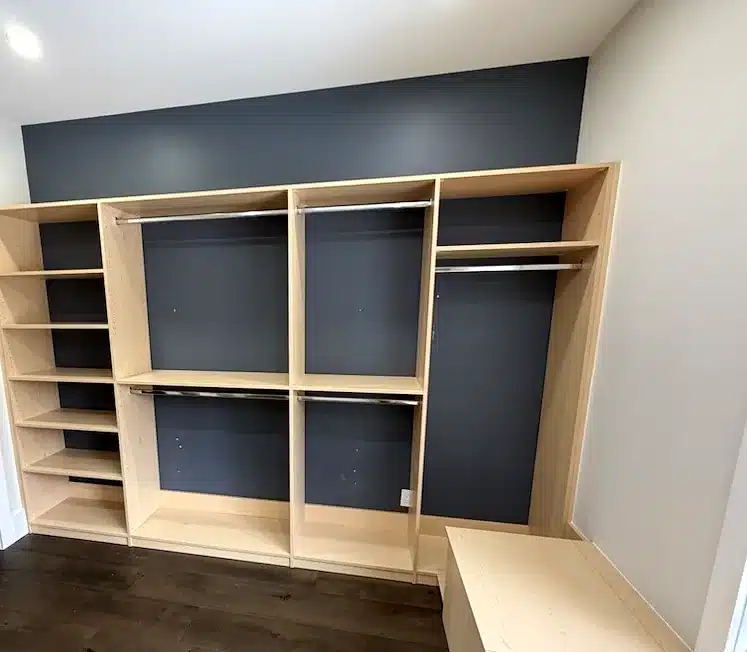
The practical reason to decide now rather than later comes down to where the wire goes. When lighting is part of the design, the channels get routed into the back of the panels in the shop, the driver gets a hidden home inside a cabinet, and the switch or sensor gets planned into the door. You see light and no hardware.
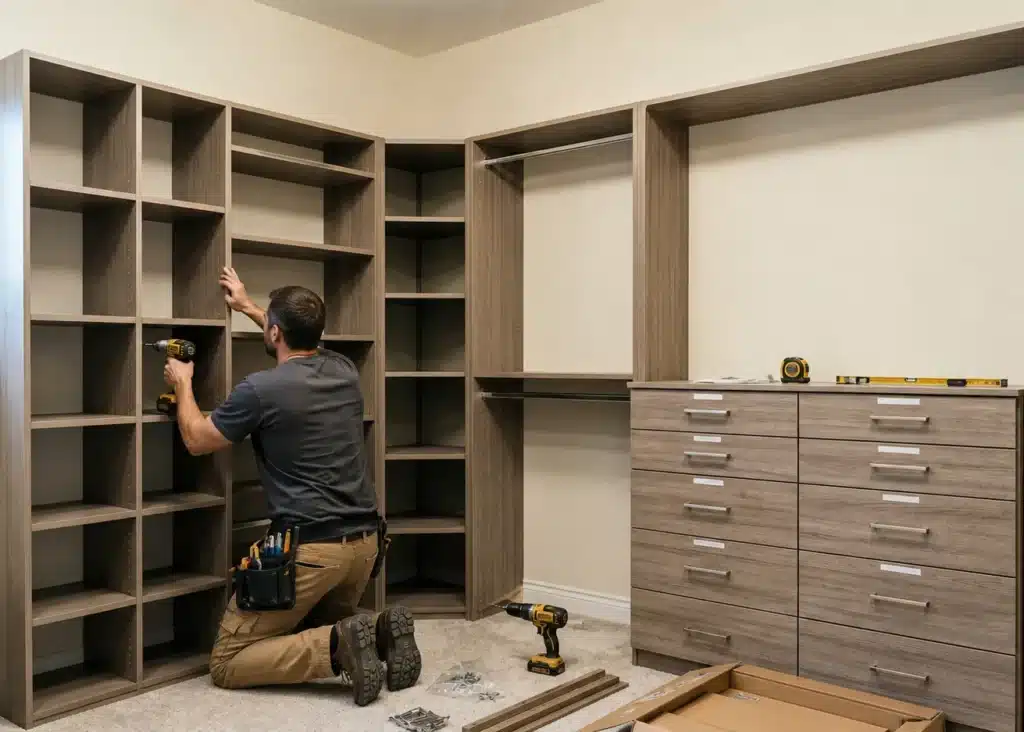
Retrofitting after the fact means surface-mounted strip, visible wire in a plastic raceway, and a driver sitting on a shelf where it takes up space and collects dust. It works, and it never looks like it was meant to be there. Nothing about the millwork itself changes: our 3/4″ thermally fused laminate construction, the thickness commercial specifications generally require rather than the 5/8″ board many systems use, routes cleanly for a wiring channel and still holds hinge and slide screws where they need to go.
See the Finishes in the Light You Actually Have
There’s a reason we bring the samples to your house rather than asking you to judge them in someone else’s building. Finish colour shifts under different light, and the only lighting that matters is the lighting in your bedroom, next to your floors and your trim, at the hour you get dressed. A designer comes to you with the samples and the tape measure, and the appointment takes about ninety minutes: measure the room, plan the layout, and work out where the strips go and what switches them on.
Read more about how we approach custom closet design from the layout up, look through the custom walk-in closets we build across Ontario, or browse the full range of custom closet systems we make. Everything is built in our Barrie workshop, installed by our own employees rather than subcontractors, and covered by the Homeowners Lifetime Warranty. When you’re ready to stop getting dressed in the dark, book your in-home design appointment.