Go and look at the stretch of counter where your coffee happens. There’s the machine. Beside it, the grinder, or the box of pods, or both because somebody in the house drinks the other kind. There’s a kettle that gets used twice a week, a jar of beans, a bag of the good beans behind the jar, a stack of mugs that didn’t fit in the cabinet, and a spoon.
That corner started as one appliance and grew. It now occupies some of the most valuable counter you own, and it collects clutter faster than anywhere else in the kitchen because none of the items on it have a proper home to go back to. A built-in coffee bar is the fix, and the reason it works has less to do with looks than with traffic.
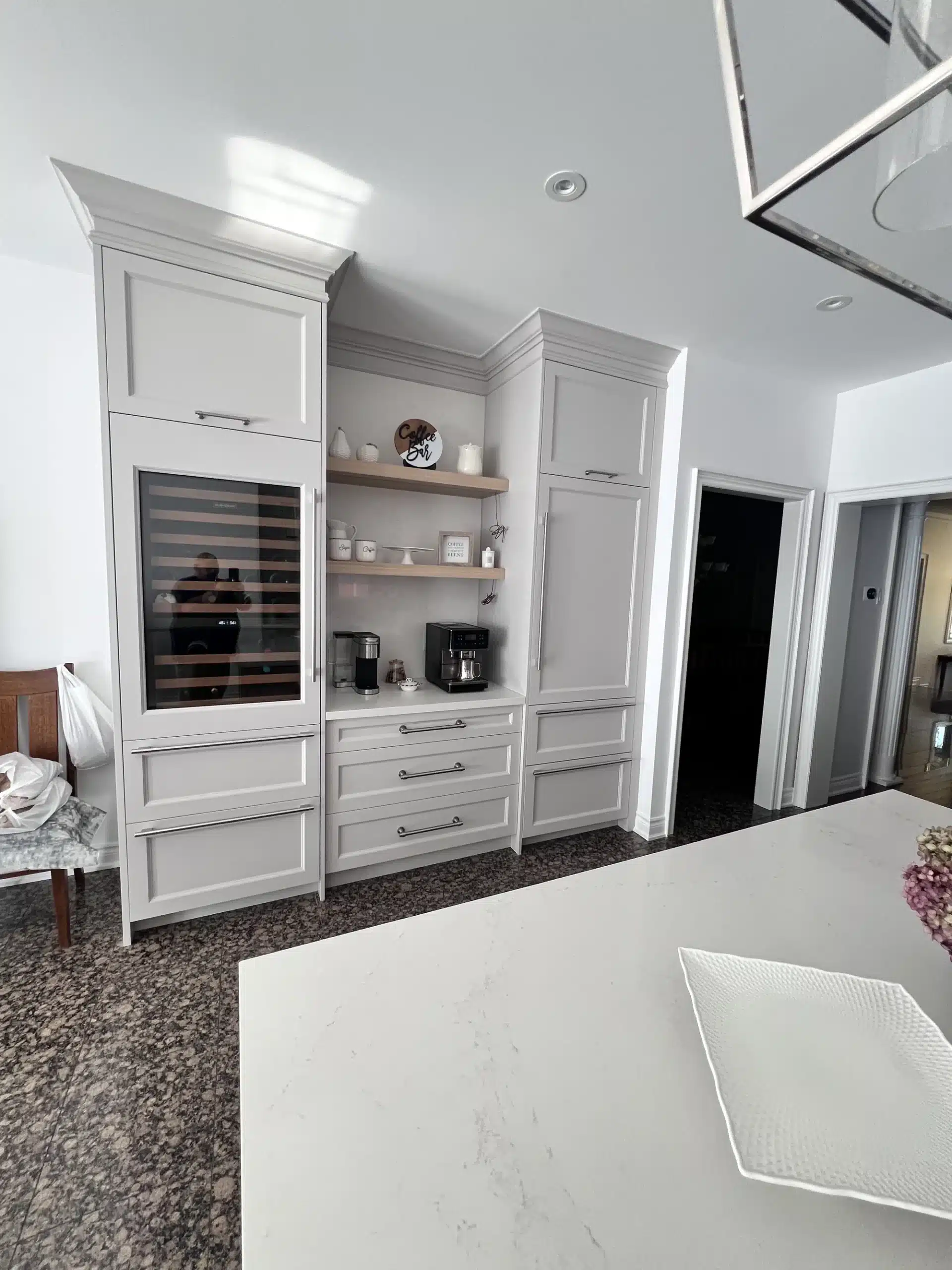
A beverage station with its own fridge, shelving and drawers. Everything that used to sit on the kitchen counter now has an address.
The Real Problem Is Who’s Standing Where at 7:20 AM
Most kitchens have one busy zone, roughly the path between fridge, sink and stove. That’s where somebody is making lunches, and it’s where the coffee machine usually ended up because that’s where the outlet was.
So every morning, the person making coffee and the person packing a lunch bag occupy the same four square feet, reaching across each other. Nobody argues about it out loud. They just find the kitchen annoying and can’t say why.
Pulling the coffee out of that zone and giving it its own station on a different wall solves a scheduling problem with cabinetry. Two people can now be doing separate jobs without negotiating. In our experience this is the change people mention months later, ahead of the finishes and ahead of the storage.
What Actually Goes Into One
A coffee bar that works is a small stack of decisions, and the counter depth is the first one. Give it enough landing surface to set a mug down while you pour, plus room for the machine’s water reservoir to lift out. Most espresso machines want more overhead clearance than people plan for, so measure yours with the lid open before anyone draws a shelf above it.
From there:
- Power in the right place. An outlet inside the cabinetry, at the back of the counter, so nothing runs across the surface. If you might add a second machine later, run two circuits now while the wall is open.
- A drawer for beans and pods. Shallow, right under the counter, divided. This is where the two coffee formats stop fighting for shelf space.
- Mugs at reaching height. Open shelving directly above, or a shallow upper. Mugs are light and used daily, which makes them one of the few things that earn a spot on an open shelf.
- Somewhere for the overflow. Filters, syrups, the travel tumblers, the French press somebody was given. A closed door below keeps that off the counter.
What Actually Goes Into One
An undercounter beverage fridge is the upgrade that changes how the station gets used the rest of the day. Milk and cream stop being a trip to the main fridge, which matters more than it sounds like it should, because that trip is what puts you back in the busy zone you just left.
A glass-front wine fridge does the same job for entertaining and looks the part in the evening. The practical note is that beverage fridges vent forward and need a specified air gap, so the cabinet has to be built around the model you’re buying. Pick the appliance before the cabinetry gets drawn, not after. Retrofitting a fridge opening into finished millwork is the expensive way to do it.

The same idea run as an evening bar: lit glass towers, a dark finish, and a back panel that makes the wall read as furniture.
The Appliance Garage, and Whether You Want One
An appliance garage is a cabinet with doors that fold back or lift away, so the machine sits on a counter inside the cabinetry and disappears when you close it up. Done well it’s the tidiest version of a coffee bar you can build, because the whole operation vanishes between uses.
Two honest cautions. First, you have to be the kind of household that closes the doors, and some households are not, in which case you’ve paid for hardware that stays open. Second, an espresso machine under a closed door produces steam, so the bay wants to be pulled out for use or built with the venting in mind. If you drink drip coffee, none of that applies and an appliance garage is close to a pure win.
The bifold and pocket-door hardware that makes this work is the same family of mechanisms behind most of the custom kitchen storage solutions we build for Ontario kitchens, and it is the part of the quote worth asking about, because cheap hinges on a door you open every day fail first.
Where to Put It
The best spot is out of the main work path but still on somebody’s way through the kitchen. A few that tend to work:
- The end of a run, past the fridge, where the counter would otherwise be a dead corner.
- A butler’s pantry or the wall between kitchen and dining room, which puts it in the right place for both breakfast and hosting.
- A short return wall by the doorway from the hall, so the first person up doesn’t have to enter the kitchen proper.
What rarely works is the far side of the island, since that’s a seating and serving surface and a machine on it will be in the way of both. If your island is where the counter pressure is, the answer is usually more storage inside it rather than another appliance on top, which is the case we made in our piece on how to get real storage out of a kitchen island.
It Doubles as a Bar Without Being Called One
The same run of cabinetry that holds beans at 7 AM holds glassware at 7 PM. A bottle drawer, a small glass-front upper, and a counter deep enough to set out four glasses turns the coffee station into the place people stand when you have company. That’s a real benefit in a house where guests otherwise cluster around the stove.
Lighting is what sells it. An LED strip under the upper cabinet lights the counter for measuring coffee and reads as ambience after dark, off the same switch.
What It’s Built From
A coffee bar takes water, steam and daily hands on the same two doors. We build with 3/4″ thermally fused laminate, the thickness commercial specifications generally require, rather than the 5/8″ board many systems use. The heavier board is stiffer under a loaded shelf and holds hinge and slide screws better, which is what you want on a cabinet that gets opened twice every morning for twenty years. TFL is also dimensionally stable where solid wood moves with humidity, and our higher-end lines include Tafisa TFL, LEED certified with up to 50% recycled content.
Finishes run traditional through modern, so the station can either match the kitchen exactly or deliberately contrast with it. The dark bar wall above is the second approach: same house, different mood, one wall.
Get Your Counter Back
A designer comes to your home with the samples, so you judge the finishes in your own light and against your own floors instead of under showroom bulbs. Kitchen projects get two appointments of about ninety minutes each: the first works out the design, the second walks you through final pricing on the design you chose.
Everything is built in our Barrie workshop and installed by our own employees rather than subcontractors, and it’s covered by the Homeowners Lifetime Warranty. Have a look at the built-in coffee bar and beverage station cabinetry we make, then book your in-home design appointment and bring a photo of the counter as it looks right now.