Let’s get our bias on the table: we build Murphy beds. We do not build sofa beds. You’d be right to read what follows with one eyebrow up.
But here’s the thing. The internet already has plenty of Murphy bed pages that treat the sofa bed as an obvious mistake, and that isn’t honest. The sofa bed wins some of these rounds cleanly. For certain rooms and certain lives it’s the correct purchase, and we’ll say so by name before this article ends. What follows is the fair fight: where each one actually wins, and how to tell which situation is yours.
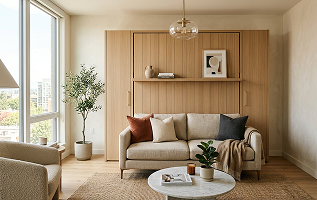
The combination option: a sofa by day, and a real bed that folds down over it when the guests arrive.
Round One: Where the Sofa Bed Wins
Nothing to install. A sofa bed arrives on a truck, gets carried in, and is a guest room by dinnertime. No measuring, no design decisions, no install day. If you need a place for your sister to sleep two weekends from now, the sofa bed is the only contender in the ring.
It moves with you. A sofa bed is furniture. When the lease ends or the house sells, it gets carried back out the same door it came in. A Murphy bed is millwork. It’s fixed to the wall, and it stays with the home. If you’re renting, or you expect to move within a couple of years, that alone can settle the argument. (For what it’s worth, built-in cabinetry stays behind as a selling feature rather than a loss, but it stays behind.)
Cheaper to get into. No suspense here: a sofa bed generally costs less to acquire than custom cabinetry with a counterbalanced bed inside it. If the budget is the budget, that’s a real win, not a technicality. The comparison gets more interesting over years of ownership (a piece of built millwork is a long-term fixture, a sofa bed is a piece of furniture with a folding frame inside it) but on the day you pay, the sofa bed asks for less.
It’s always a sofa. Obvious, but worth saying: if the room’s main job is sitting (a TV room, a family room) the sofa bed does that job every single day without being asked to transform.
Round Two: Where the Murphy Bed Wins
Your guests sleep on a real mattress. This is the point most comparisons bury, and it’s the sleeper of the whole fight, in every sense. A sofa bed’s mattress has to fold in thirds and live inside a sofa, which is why it’s thin, and why there’s a support bar your guest finds with their spine at 2 a.m. A Murphy bed takes a standard, full-depth mattress, the same kind on your own bed, because the bed doesn’t fold; it simply tilts up into its cabinet, bedding and all. Nobody has ever described a sofa bed the way guests describe a proper mattress, which is by not mentioning it at all. Good sleep is the one thing a guest bed is for.
The room stays a room the other 350 nights. A sofa bed solves the guest problem by occupying the room full-time. A Murphy bed solves it by disappearing. The cabinetry-integrated wall beds we build use counterbalanced mechanisms that lift the bed away with an easy motion, and when it’s up, the wall is simply cabinetry, which means the room underneath gets to be whatever it actually is: an office, a gym, a studio, a den with its floor back.
It brings storage with it. A sofa bed stores nothing but its own mattress. A Murphy bed lives inside a wall of millwork, and that wall works: wardrobe towers beside the bed, cabinets above it, shelving, sometimes a desk that stays flat while the bed comes down behind it. A wall bed with storage built around it often replaces a dresser, a bookcase and a closet’s worth of overflow in the same footprint the bed was already using. In a small home, that consolidation is the difference between a room that functions and a room that’s furniture soup.
Daily usability. Here’s the quiet failure mode of the sofa bed as a guest room strategy: unfolding it is enough of a production (cushions off, frame wrestled out, bedding hunted down) that the “guest room” slowly becomes the room nobody converts. A Murphy bed comes down in moments, made and ready, because the bedding stays on it. Furniture that transforms easily gets transformed; furniture that transforms grudgingly just gets sat on.
The Room the Other 350 Nights
Step back from the hardware and the real question comes into focus. You’re not choosing between two beds. You’re choosing what the room is for the fifty weeks a year nobody’s visiting.
With a sofa bed, the answer is fixed: it’s a sitting room with a secret. With a Murphy bed, the answer is open: home office with a guest room inside it, gym with a guest room inside it, hobby room with a guest room inside it. If you work from home, that arithmetic is hard to argue with. The desk earns its keep two hundred days a year; the bed, maybe fifteen. The room should be designed for the two hundred.
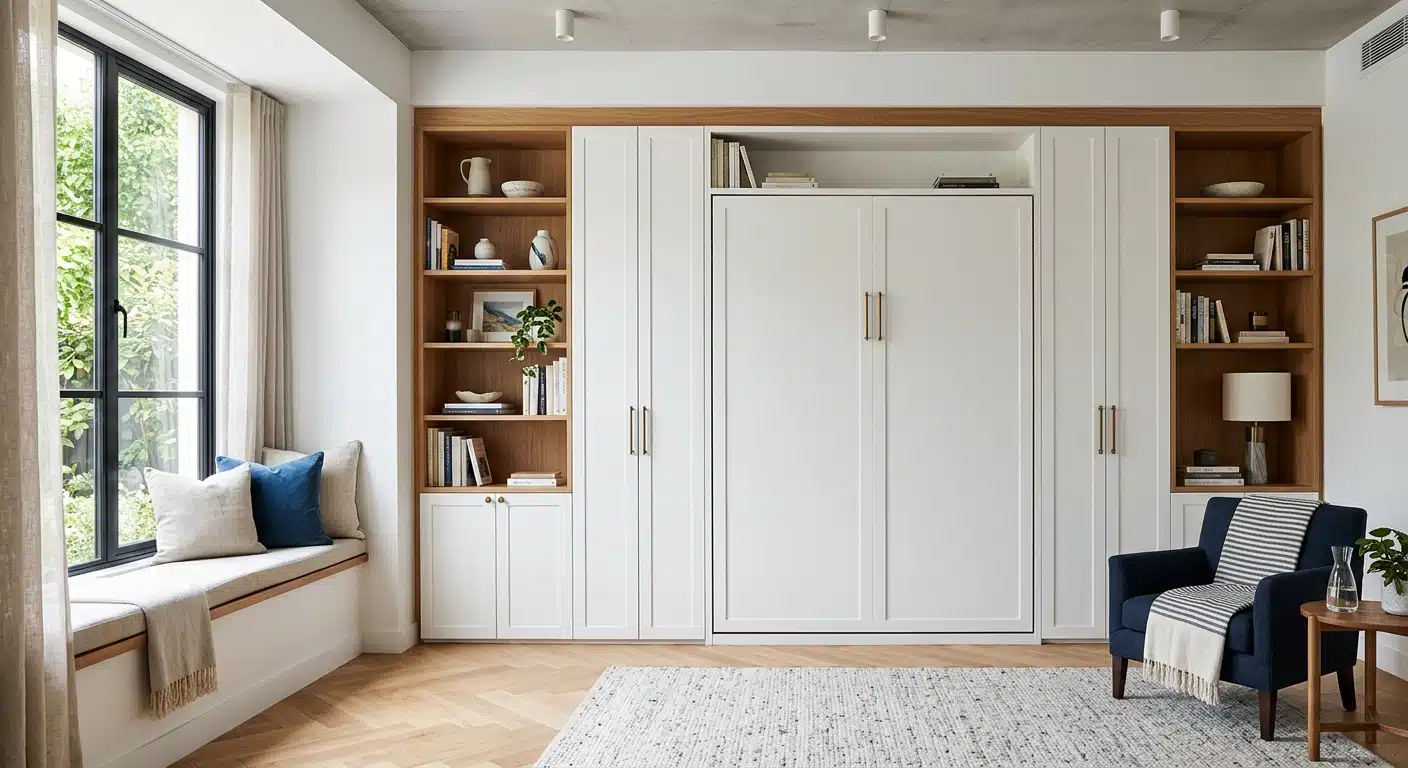
Bed up, the room goes back to work, and the wall goes back to being cabinetry.
The Option That Refuses to Choose
There is a third answer, and it’s the right one for a specific room: the space that really does need seating every day and a real bed sometimes, a TV den that doubles as the guest room, say. A Murphy bed with a sofa built in front of it puts a proper sofa against the cabinetry, and the bed folds down over it when needed. Daily sofa, real mattress, one footprint. It’s the configuration for people who read the two rounds above and honestly scored it a draw.
The mechanism is far easier to watch than to describe. This video of a vertical-opening unit with a sofa and a shelf shows the whole movement: the bed comes down over the seating, and the shelf in front of it stays level the entire way, so whatever is on it doesn’t have to be cleared off first. That last part is the bit nobody believes until they see it.
Our Honest Scorecard
Buy a sofa bed if: you’re renting; you’ll move within a year or two; guests are rare and undemanding; the budget needs the smaller number; or you need the problem solved by the weekend. That’s not a consolation prize: in those situations a sofa bed, honestly, is what we’d tell a friend to buy.
Choose a Murphy bed if: you own the home and plan to stay; the room needs a real daily function (office, gym, studio) alongside occasional guests; the people staying over are ones whose backs you care about; or the room needs storage as badly as it needs a bed.
Choose the sofa combination if: the room’s daily job is sitting and its occasional job is real sleep, and you’re unwilling to shortchange either.
The pattern underneath: the sofa bed is the right call when the situation is temporary. The Murphy bed is the right call when the room is permanent and being asked to do two jobs well.
Come See Which Room You Actually Have
If you’ve read this far and you’re still in the fight, the tiebreaker is your own four walls. A designer comes to your home (with the samples, so you see the finishes in your lighting, next to your floors) measures the room, and works through the layout with you in about ninety minutes, in styles from traditional to modern. Everything is built in our Barrie workshop from 3/4″ thermally fused laminate, installed by our own employees rather than subcontractors, and covered by the Homeowners Lifetime Warranty. Book your in-home design appointment, and if it turns out your situation is a sofa-bed situation, we’ll tell you that too.