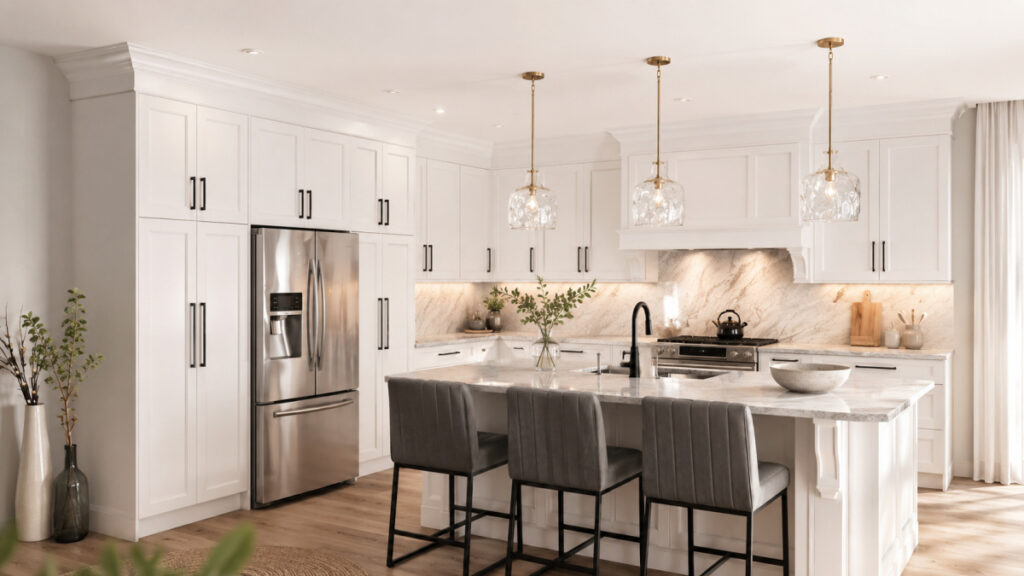
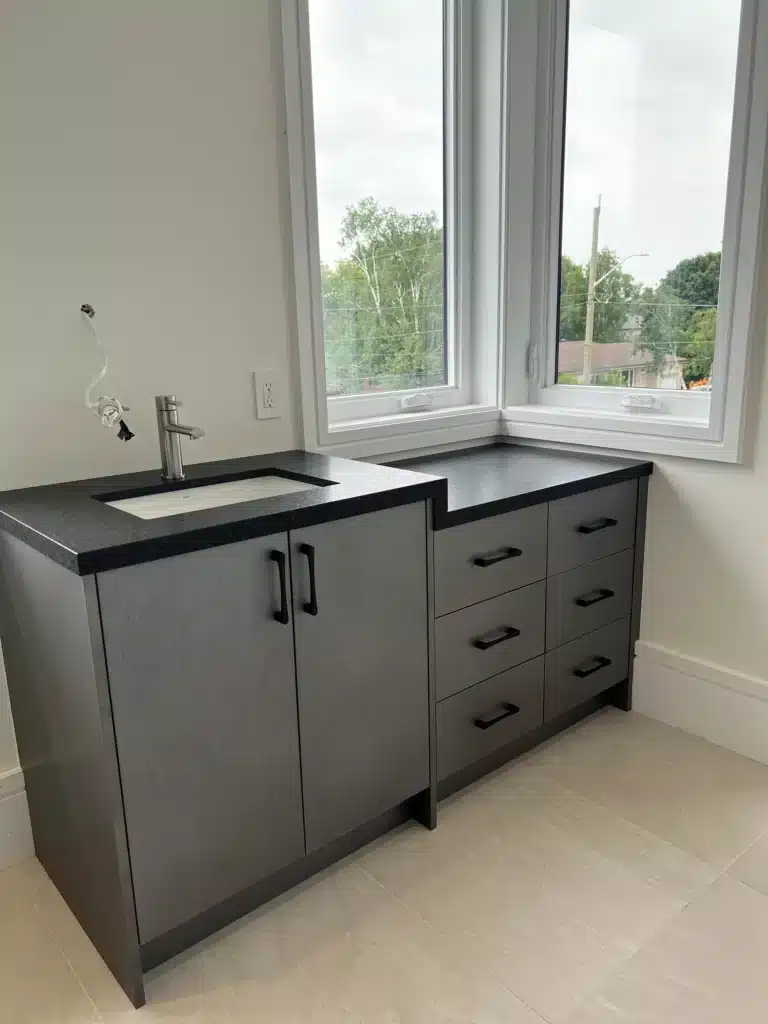
Door style is usually the last thing decided at a design appointment and one of the first things that moves the price. Two doors can look similar from across a room and be very far apart on the invoice.
The reason is duller than most people expect. A door costs what it costs us to get it, and that depends almost entirely on which piece of equipment makes it and whether we own that equipment.

Finish and door style are the two decisions that move a closet quote most, and neither changes how much the closet holds.
Contemporary
A slab door in TFL. We make these in our own shop at 73 Saunders Rd, because a Contemporary door needs no special machinery beyond what is already cutting your panels and shelves.
That is why it sits at the bottom of the range. Nothing is being outsourced and no third party is adding a margin. If you like a clean modern look, the least expensive door we offer is also the one that gives it to you, which is a rare piece of good luck in this business.
Decorative, or DECO
A plastic wrap applied over sanded MDF. The sanding is the point, because it lets the MDF take a shaped profile instead of staying a plain slab. That is how you get a door with a routed edge or a raised centre panel.
The wrap needs a thermal wrap machine, which is expensive to buy and expensive to run. We do not own one, so DECO doors come from a third-party supplier, and their cost carries their equipment and their margin. That is most of the price difference against a Contemporary door, not the material itself.
Five-Piece
Exactly what the name says. Rather than shaping one board, a five-piece door is built as separate components and then assembled to create the look: two stiles, two rails, one centre panel.
No thermal wrap machine required, so it avoids that particular cost. What it adds instead is labour, because assembling five parts into one door takes real hands-on time. That work sits with a third-party supplier too.
Painted
Always MDF, and there is a production reason rather than a preference behind that. Paint needs a surface it can bond to, and MDF can be sanded to give it one. Board products with a fused surface cannot take paint the same way.
Painted is our premium tier and it is priced there. Different board, extra surface prep, a finishing step, and a much lower tolerance for anything less than perfect, since paint shows every flaw a wrap or a laminate would hide.
If your heart is set on a specific colour that is not in our standard range, this is the door that gets you there. Go in knowing it is the top of the price list rather than a small adjustment.
Real Wood
Solid wood, stainable so the grain shows. It is the most popular choice in kitchens and it turns up less often in closets, partly because most of a closet’s interior is never seen.
It is a premium natural material and it prices like one. It is also the only option on this list where the material itself, rather than the equipment, is the main driver of the number.
The Five Side by Side
| Door type | Material | Made where | Cost driver |
|---|---|---|---|
| Contemporary | TFL | In our own shop | Nothing outsourced |
| Decorative (DECO) | MDF only | Third party | Thermal wrap machine |
| Five-piece | MDF, sometimes TFL | Third party | Assembly labour |
| Painted | MDF only | Premium tier | Surface prep and finishing |
| Real wood | Solid wood | Premium tier | The material itself |
The Rest of the Closet Has Options Too
Doors get the attention, but the material question is not limited to them.
High-end plywood can be used anywhere: panels, shelves, doors. It takes paint or stain, depending on what you are after. Specialty woods like walnut and birch are available as well, and stain brings out the character in both. All of it is available and all of it adds to the final number. There is no version of this where a premium material arrives at a standard price. The board-level question is covered in our post on what “custom” should mean in a cabinet.
The Question Worth Asking About Doors
Before any of it: does the closet need doors at all?
Doors are aesthetic. They do not change how a closet functions. Inside a walk-in they hide your clothes from nobody except you, since the room already closes. In an open space they earn their money by hiding contents from anyone who can see into the room. On a standalone wardrobe or a built-in under the stairs they are part of the piece, and without them the unit reads as a gap in the wall rather than furniture.
That is four different answers to the same question, and only two of them are about function. Worth sorting out which situation you are in before you start comparing door styles, because the money saved by skipping doors inside a walk-in usually buys the drawers you actually wanted. The whole cost picture is on what a custom closet costs in Ontario.