Stand two white shaker cabinets side by side on installation day and you will not be able to tell them apart. Same doors, same handles, same soft-close hush, same clean bright white. Shuffle the photos and even the installers might hesitate.
Come back in three years and open the pantry.
In one, the shelf under the stand mixer and the flour bin is still dead flat. In the other, the same shelf has developed a faint smile: a few millimetres of sag in the middle, the kind of thing you notice once and can never stop seeing. Nothing broke. Nothing failed, exactly. The cabinet just quietly told you what it was made of.
This post is about that difference. Not to alarm you: to arm you, because the difference is invisible in every photo, every render and most quotes, and it becomes one of the easiest things in the world to ask about once you know it exists.
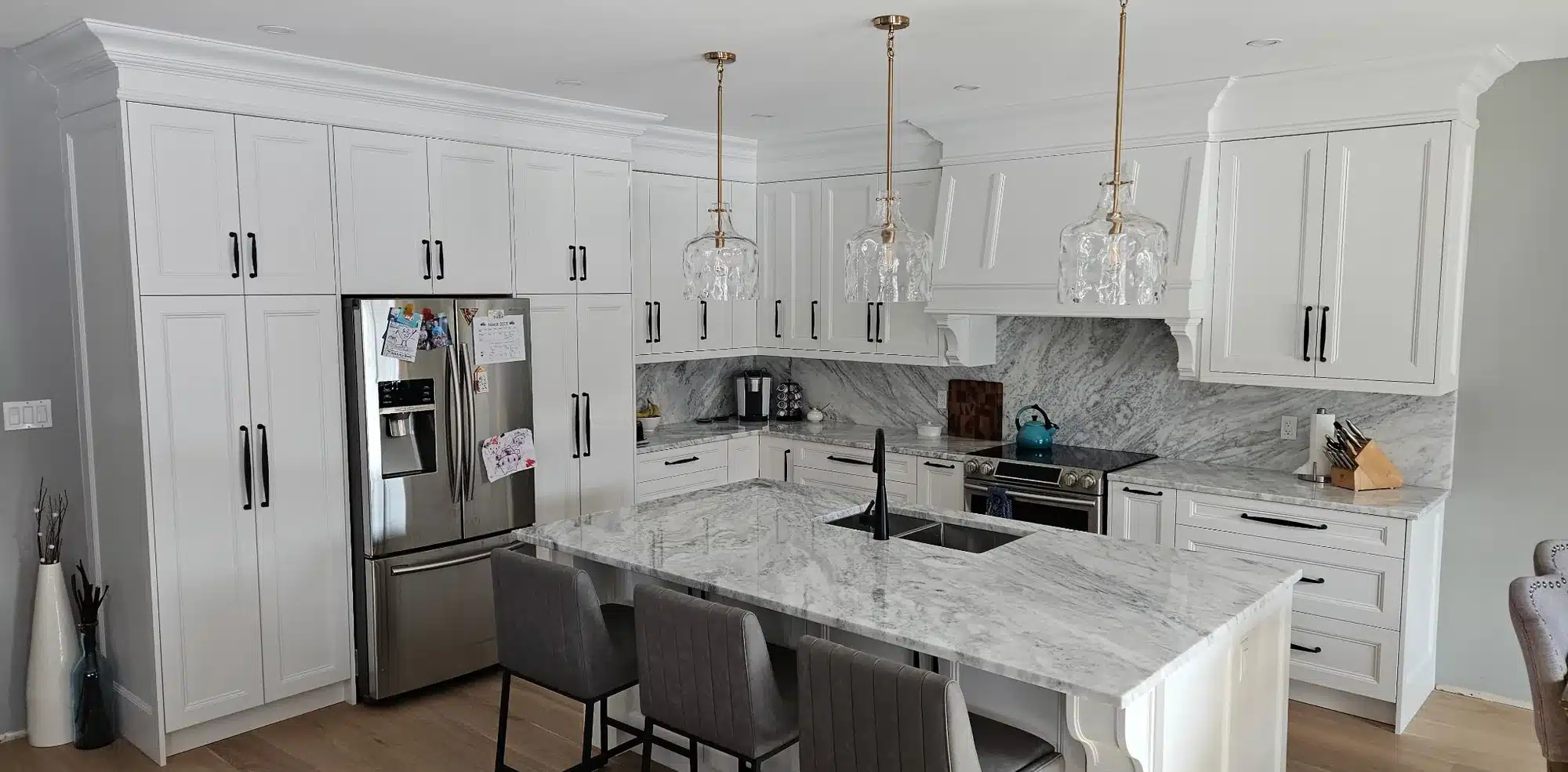
Two kitchens can photograph identically on installation day. The board behind the white is the part no photo shows.
White on the Outside Tells You Nothing
The finish is the part you fall in love with, and fair enough. It’s the part you’ll look at for twenty years. But the colour on the outside says nothing about the board underneath it. Two cabinets wearing the identical white can be standing on completely different material, and the industry does not make this easy to see. Quotes describe door styles, finishes, hardware upgrades. The board itself, the actual structure of the thing, often appears nowhere on the page, or hides behind a phrase like “engineered panel.”
White on the outside; what’s inside counts. So here is the plain version of what’s usually inside, and why the gap between the two options widens with every year the cabinet is in service.
An Eighth of an Inch, Cubed
A great many cabinet and closet systems are built from 5/8″ furniture-grade board, because it costs less and weighs less, and on day one it works fine. We build with 3/4″ thermally fused laminate (TFL), the thickness that commercial specifications such as AWMAC and AWI generally require for casework.
An eighth of an inch sounds like a rounding error. It isn’t, because of one unglamorous piece of physics: a panel’s bending stiffness scales roughly with the cube of its thickness. Work that through and the 3/4″ panel comes out roughly 60 to 70 per cent more rigid than the 5/8″ panel over the same span. Not slightly stiffer. Most-of-again stiffer.
Here’s what that abstraction looks like in a house. A shelf’s job gets harder the wider it spans, and real life loads shelves without mercy: the pantry shelf that collects the slow cooker and every canned good, the closet shelf stacked two-deep with winter sweaters, the cabinet bottom that carries the cast iron. Over a short span, both boards look fine for years. Over the wide spans people actually want (the uninterrupted runs in your saved photos) the thinner board slowly bows under real load while the 3/4″ board holds flat. Sag isn’t a day-one defect; it’s a compound-interest problem. The board that’s most-of-again stiffer is the one still paying out flat shelves a decade in.
Your House, Built to the Spec Offices Require
The commercial framing is worth pausing on, because it answers the reasonable question of whether 3/4″ is overkill for a home. Commercial casework standards exist because offices, clinics and institutions can’t afford millwork that needs replacing. The specifications are written around decades of indifferent daily use by people who don’t own the cabinets. Those specs generally call for 3/4″ panels.
Your kitchen sees kinder users and harder love. Nobody in an office slams a drawer with a hip because their hands are full of groceries. When we build your custom kitchen cabinets to the same panel thickness that commercial work demands, it’s not a flourish. It’s the same logic. A kitchen is the most heavily used millwork in any building you’ll ever live in. It deserves at least the spec a filing room gets.
The Screws Are the Other Half of the Story
Stiffness gets the attention, but the screws matter just as much, and they’re even more invisible in a quote.
Every hinge and every drawer slide in your kitchen is held by screws threaded into the board. A hinge on a daily-use cabinet door cycles thousands of times a year; a drawer slide carries a moving load every single time. Thicker board gives those screws more material to bite into and hold, which is the difference between hardware that stays tight for decades and the sagging door or wandering drawer that gets “adjusted” every few months until the screw holes give up. The same is true in a bedroom: the drawer banks in our custom closets and dressing rooms across Ontario ride on the same 3/4″ board for the same reason. Closet drawers get opened more often than almost anything in the house.
Why Laminate Instead of Solid Wood
The other question we’re asked, usually a little suspiciously: if you care so much about material, why not solid wood?
Because solid wood moves. It swells and shrinks with humidity, and an Ontario house swings from furnace-dry January to sticky August every single year. A solid wood door can twist and creep through those cycles; a TFL panel is dimensionally stable, so doors stay true and reveals stay even through decades of seasons. That stability is part of what makes our Homeowners Lifetime Warranty realistic rather than optimistic. You can only promise a lifetime of straight doors on a material that doesn’t argue with the weather.
Where Our Board Comes From
Not all TFL is equal either, so it’s fair to ask where ours originates. We source from established board manufacturers, many of them making their panels here in Canada: our higher-end lines include Tafisa TFL, which is LEED certified and made with up to 50 per cent recycled material. If building with Canadian-made materials matters to you, we’ve written more about what Canadian-made means in our cabinetry. Good board from an accountable mill is the quiet foundation under everything else on this page.
How to Ask Any Quote What It’s Standing On
You don’t need to become a millwork expert to protect yourself here. Whoever you’re talking to, including us, three questions will surface the whole story:
- How thick is the board, everywhere? Not just the doors: the shelves, the cabinet boxes, the drawer banks. If the answer is a shrug or a brochure word, that’s an answer too.
- What is the board, and who makes it? A builder proud of their material will name it without checking. “Engineered panel” is a category, not an answer.
- What holds the hinges and slides, and for how long? Ask what happens in year eight when a door sags. The warranty conversation gets very specific very quickly.
None of this is a trick. A quote built on good board answers all three in one breath and is glad you asked. And if a surprisingly low number suddenly makes sense once you learn what it’s built from: well, now the two quotes are finally describing different things, which is all we wanted.
See the Board in Your Own Kitchen
The easiest way to understand the difference is to hold it. When you book a design appointment, one of our designers comes to your home with the samples (board, finishes, hardware) so you see everything in your own lighting, next to your own floors. For closets and storage it’s one visit of about ninety minutes; for kitchens it’s two, the first for design and the second for final pricing, because kitchens deserve the extra pass. Everything we build is made in our Barrie workshop from that 3/4″ board, installed by our own employees, not subcontractors, and covered by the Homeowners Lifetime Warranty. We’ve spent over ten years building custom storage in Ontario on the belief that the inside of the cabinet should be as honest as the outside. Book your in-home design appointment and ask us the three questions. We like them.