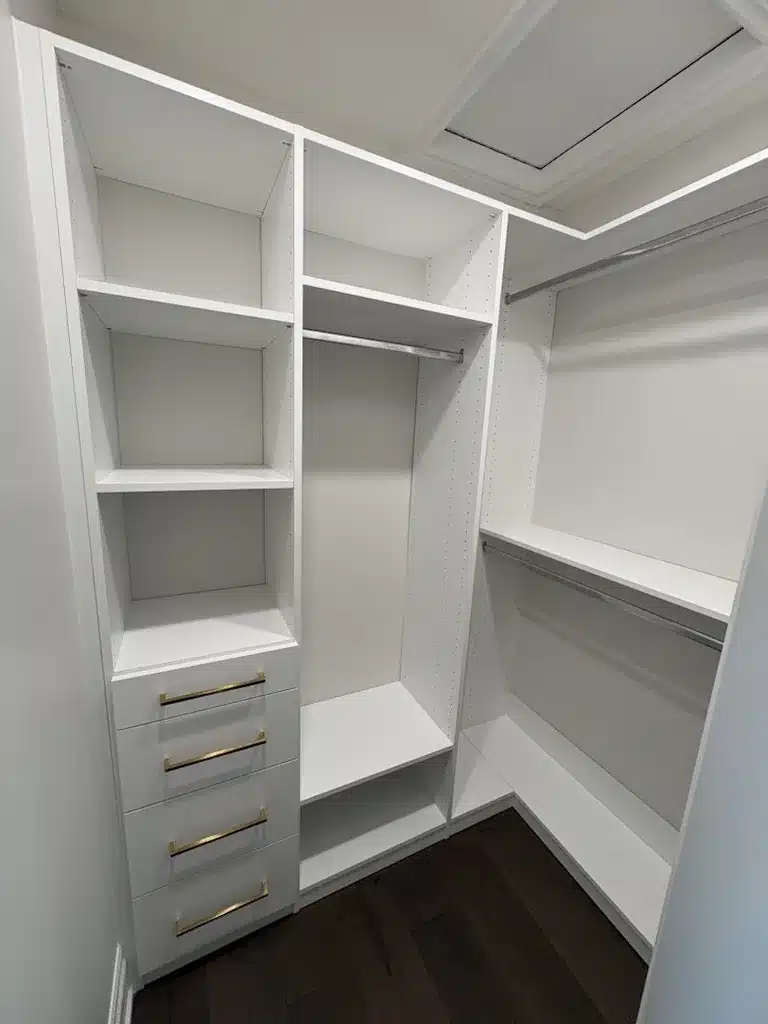
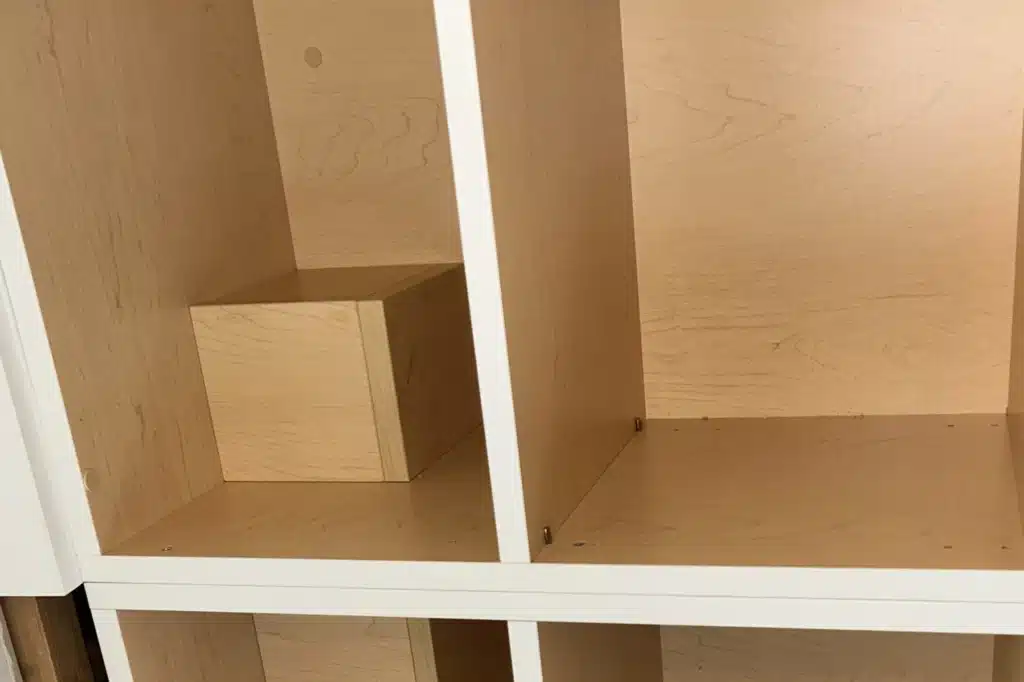
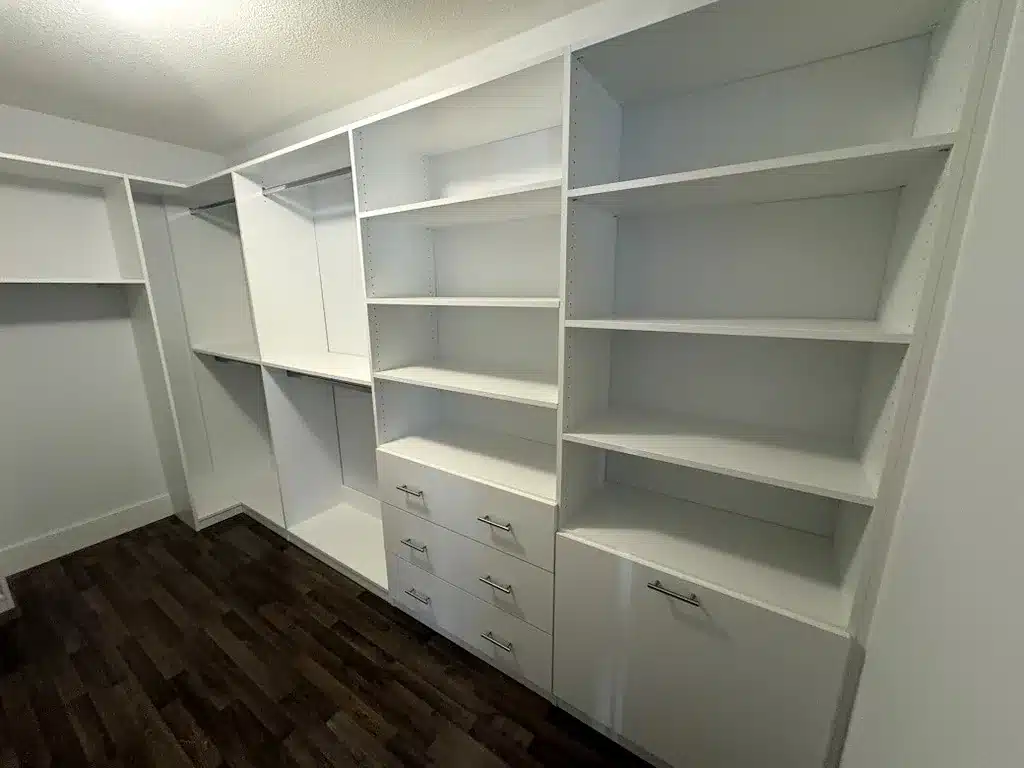
This is the decision that moves a closet quote more than almost anything else, and most people make it on instinct in about four seconds. Drawers feel like the grown-up option, so drawers go in the plan.
Sometimes that is right. It is worth knowing what you are trading first, because a drawer costs you twice: once on the invoice, and once in storage you do not get back.
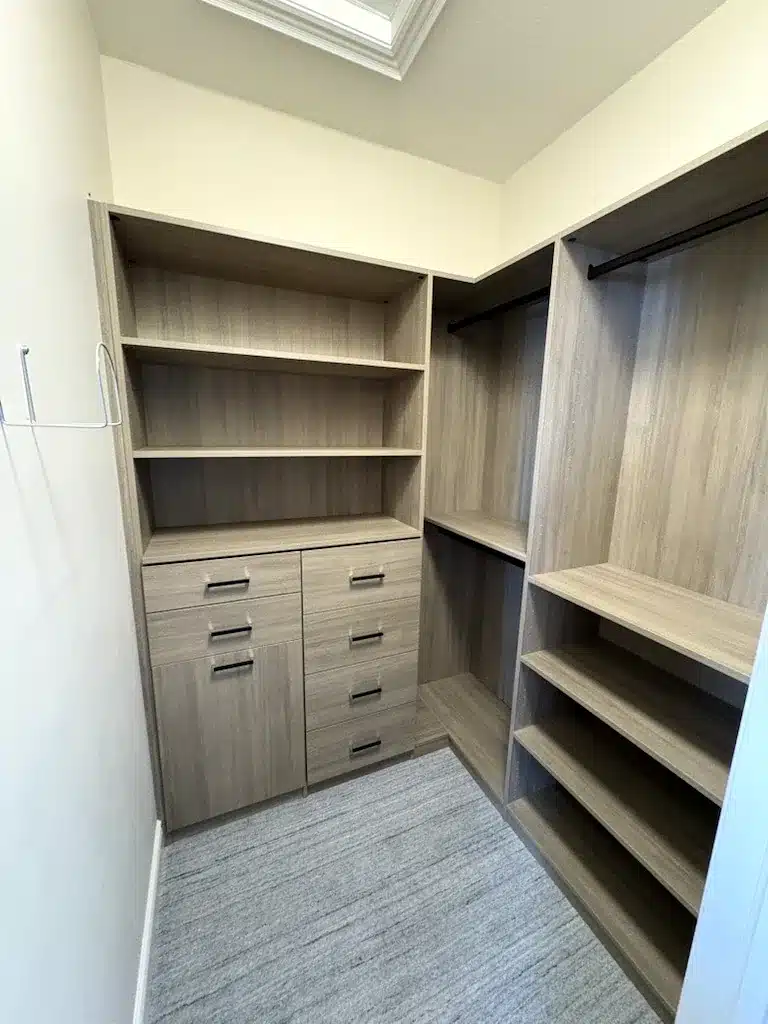
Open shelving handles volume, the drawer bank handles small items. That split is usually the cheapest closet that still works.
A Shelf Gives Up Nothing
A shelf uses 100% of its space. There is no mechanism, no clearance requirement, no dead air. You can stack it to the underside of the shelf above and then stack it a bit past that, and it still works.
It is also the simplest thing we make. A shelf is a flat board, cut to your opening, edge-banded so the cut edge is finished. Less machining, less hardware, less install time.
The drawback is real and worth saying out loud: an overloaded shelf looks overloaded. Mess sits in plain view, because a shelf has no walls to hide anything behind. If tidiness is something you fight with rather than something that comes naturally, open shelving will hold you to a standard you may not want to be held to.
A Drawer Trades Space for Containment
A drawer has to open, which means it needs clearance, which means some of the space it occupies is space you cannot fill. That is the storage cost, and it is unavoidable at any price point.
What you buy with it is containment. Whatever the state of your socks, the drawer front looks the same when it is closed. That is not a small thing. For plenty of households it is the entire reason the closet stays looking finished six months after we leave.
Drawers can also lock, which matters if you keep jewellery or anything else you would rather not leave on an open shelf.
What Actually Belongs in a Drawer
Small things. Underwear, socks, watches, jewellery, belts. Items that would fall over, roll away or disappear into a pile on a shelf.
What does not need a drawer: folded sweaters, jeans, handbags, hats, most linens. Those all sit perfectly well on a shelf, and putting them in drawers is where a lot of closet budgets quietly go.
The pattern we see on jobs that land well is a bank of two to four drawers doing the small-item work, with open shelving handling volume. The pattern we see on jobs that come in high is drawers everywhere, chosen at the design table because drawers felt like the premium answer.
The Upsell That Stopped Being an Upsell
If you have been quoted before, you have seen a line about soft-close.
Undermount soft-close slides used to be the upgrade. They are now what the industry builds as standard, because at volume most manufacturers default to undermount soft-close, which puts them at the same cost as a basic side-mounted soft-close slide. The nicer drawer action is not really an upgrade in 2026. It is what a drawer is.
So if a quote is charging you extra for a gentle close, ask what specifically you are paying for. It might be a real upgrade in the slide itself. It might be a line item that stopped meaning anything a few years ago.
Why a Drawer Costs What It Costs
A drawer is not one cost, it is a stack of them, which is why adding four moves the number more than people expect.
There is the box and the hardware. There is the machining: the CNC setup and run, plus edge banding on every cut edge. Then there is the handling and install, because a drawer box has to be built, moved and fitted without getting damaged on the way.
A shelf skips most of that. Same board, one cut, one banded edge, drop it in.
How to Decide
Two questions get you most of the way.
First, what small items do you own enough of to justify a dedicated home? Count them honestly. That number, not the look of the elevation drawing, is your drawer count.
Second, how much do you care that the closet looks tidy when it is not? If the answer is a lot, buy more drawers than the first question suggested and treat the difference as money spent on how the room feels rather than on how much it holds. That is a legitimate purchase. Just make it on purpose.
The drawer-to-shelf ratio is one decision inside a larger one. For the rest of it, including the changes that cost nothing and come before any of this, see our run-through of closet organization ideas sorted by cost.
When we quote, we start with the functional build and price drawers as a separate line, so you can see what each one adds and move the count up or down before anything gets cut. That is the point of quoting by component. The full picture is on what a custom closet costs in Ontario, and the shelf depths and rod heights behind it are on closet dimensions.