Count what a child’s bedroom goes through. The crib becomes a toddler bed and then a real bed. The change table gets sold. The little dresser that fit under the window goes to the basement around age nine, because its drawers stopped holding a season’s worth of clothes. The nursery bookcase ends up in somebody’s garage.
The closet in that room, if it was built properly, is the same closet when they leave for school. Nothing about it gets replaced. It changes instead, and the way it changes is duller and better than most parents expect. Somebody moves a rod up a hole.
The Column of Holes Nobody Points Out
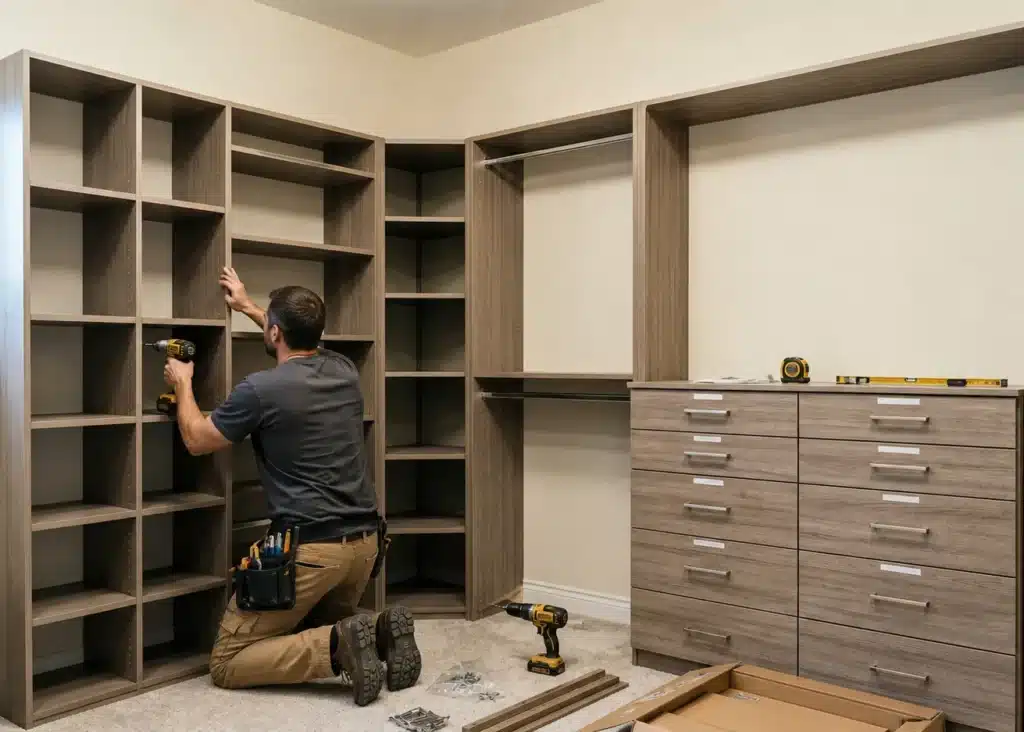
Every vertical panel in a system we build has a column of holes running its full height. They get drilled in the shop before the panel is ever loaded on a truck, and they add nothing to the price, because drilling them is part of making the panel.
Those holes are the whole mechanism. A shelf sits on pins that go into them. A rod bracket bolts into them. A pull-out basket or a drawer runner screws into them. Every horizontal thing in the closet lands in the same grid, which means any of it can come out and go back a few holes higher.
Where the Rod Starts, and Where It Ends Up
For an adult, a single rod carrying a mix of clothing sits at 66 to 72 inches off the floor. A four-year-old cannot see the underside of that rod, never mind hang anything on it. So it doesn’t start there.
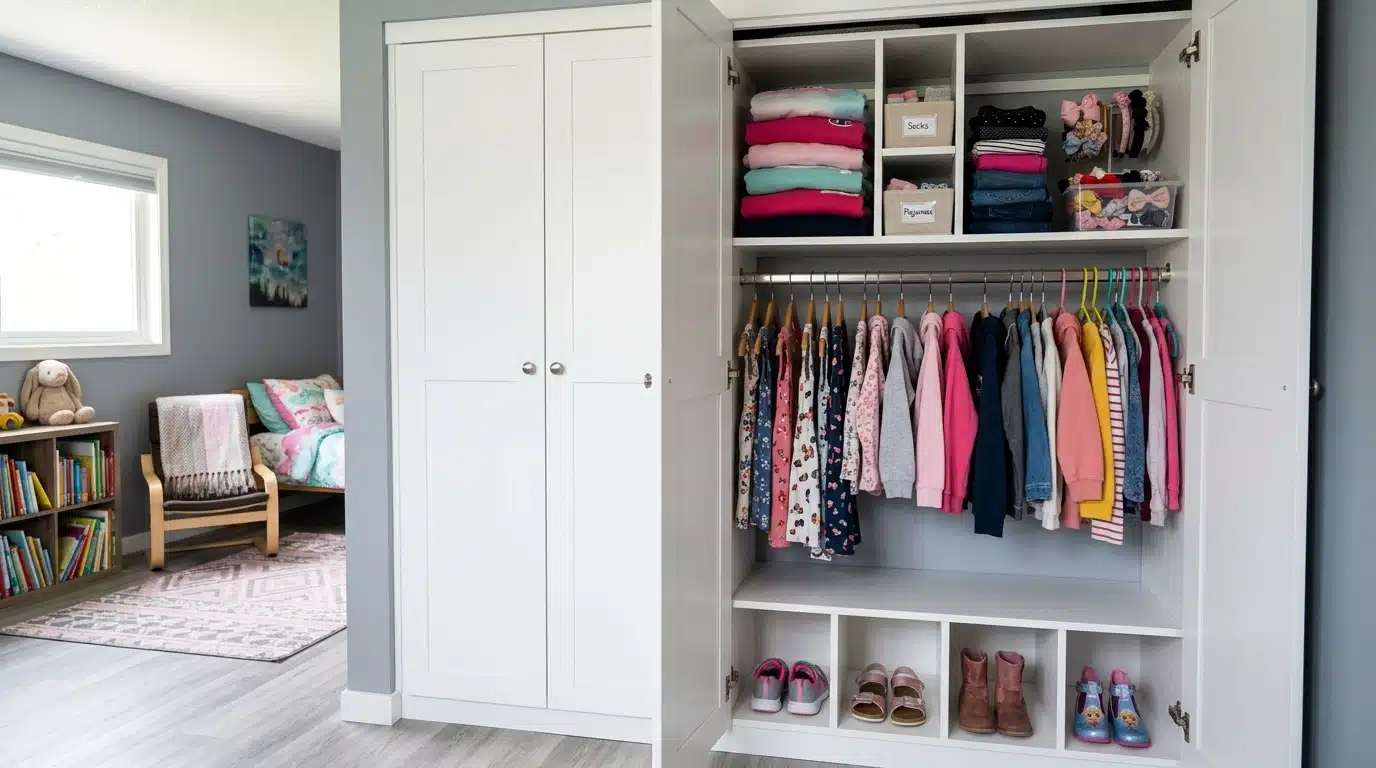
We set the first rod down around the height we use for the lower rod of a double-hang section, 40 to 42 inches. A four-year-old can reach that. They can hang up their own coat, and they can pick tomorrow’s shirt themselves, which is either a gift or a problem depending on the shirt.
Then it moves. Not on a schedule and not all at once. You notice they’ve stopped reaching up for a hanger, and the next weekend the rod goes up a few holes. Do that four or five times across ten years and you arrive at adult height anyway, having skipped the decade where the closet was useless to the person living in it.
The alternative is a rod at 66 inches and a five-year-old dragging clothes off it by the hem.
What It Costs to Move It
Nothing. That is the part worth being blunt about, because it’s the reason the closet outlasts the child.
Moving a rod up is two brackets, a screwdriver and about ten minutes. No new hardware, since the brackets you already own fit the holes you already have. No service call, no trip to the store, no waiting on a part. Nothing gets cut, so nothing needs re-finishing, and the panel looks the same afterwards because the holes were always there.
A fixed system doesn’t work that way. If the rod is screwed into drywall or into a fixed cleat, moving it means new holes, patching, paint, and a rod that no longer lines up with the shelf above it. That is the afternoon most people decide not to have, which is how a closet ends up frozen at the height it was installed.
Shelves and Baskets Move on the Same Grid
The rod is the obvious one. Over ten years the shelves matter more, because what a child owns changes category faster than it changes size.
Board books need about four inches of clearance and there are forty of them. Then it’s chapter books. Then it’s a hockey bag, a school laptop, a hair dryer and a speaker. Then it’s shoes, which by fifteen have taken over a shelf of their own. Every one of those wants different spacing, and the honest answer to how far apart closet shelves should sit is that it depends entirely on what’s going on them.
So they move. Pull the pins, drop the shelf two holes, put it back. Baskets and pull-outs come out and go back the same way, which is how the low open bin a five-year-old throws socks into becomes the deep drawer a fifteen-year-old keeps shut.
What Doesn’t Move, Because Something Has To
Adjustable isn’t infinite, and it’s worth knowing where the limits sit before you plan around them.
The panels stay where they are. So does the width of each bay, which sets how wide a shelf can be before it starts to sag, and the depth, which for hanging clothes is 24 inches because a coat hanger is about 17 to 19 inches across and needs to hang square to the wall. A drawer bank is built as a unit and stays a drawer bank.
Fixed shelves are also stiffer than adjustable ones and they look cleaner, so there are spots in any closet where fixed is the better call.
Which makes the bay layout the decision that actually matters, since the bays are the part nobody gets to change later. A closet planned around a four-year-old’s wardrobe and nothing else will adjust its way into a shape that doesn’t work at fifteen.
The Cheaper Version of the Same Ten Years
Underneath all of this is an arithmetic that turns it into a spending decision rather than a nice feature.
Most kids’ storage gets bought three or four separate times. A dresser at two, a closet kit at five, a taller dresser and a bookcase at nine, a stack of plastic drawer towers at twelve when none of it is holding anymore. Each one is a purchase, a delivery, an assembly evening, and a thing to get rid of later.
A built-in absorbs all of that on day one and then stops costing money. Hanging, shelving, drawers and the bins live in one unit, and the unit adapts instead of being replaced. It’s the only piece of furniture in that room where the second purchase never happens.
And Then They Leave
Which is the last argument for building it once. Rooms change jobs. The nursery becomes a kid’s room, then a teenager’s room, then a guest room or a home office, and the closet is the only thing in there that survives all of it without being carried down the stairs.
At that point the rod goes up to adult height, the shelves re-space for towels or files or whatever the room holds now, and it’s a closet for a grown-up. Same panels, same holes, no invoice.
If you want the layout side of this, our post on kids’ closets that still work in five years covers where the bins and the hamper and the shoes go, and there’s a section on building a kid’s closet to grow in our reach-in closet ideas. The systems themselves are on our custom closets page, and we build the same way for mudroom cabinets and laundry room cabinets. Everything gets cut in our own shop in Barrie and installed by our employees. A designer comes to your house with the samples and the tape measure, and the appointment runs about ninety minutes. Book an in-home design appointment when you want somebody to measure the room and the child standing in it.