Every closet we design in an owner-occupied house starts with questions about the person standing in the room with us. How many long coats. Whether she folds her sweaters or hangs them. Which side of the bed he gets dressed on. Those answers are what makes a fitted closet worth paying for, because they’re the part a catalogue can’t know.
In a rental, we can’t ask a single one of them. The person who’ll open that closet every morning for the next few years hasn’t even seen the listing.
One of our designers puts it plainly: you don’t build it too specific, because you never know how the next person is going to be. That sounds like a limitation. Used properly it’s a design brief, and it produces a better closet for the job than a personalised one would.
The brief landlords actually give us
Homeowners describe a wardrobe. Landlords describe a standard.
What we hear, near enough word for word, from owners with one unit and owners with a dozen: it doesn’t have to be perfect for anybody in particular, and it does have to present well. Then a third thing, usually said last and meant hardest. It can’t become a phone call.
That last one drives more of the design than people expect. Any feature in a rental closet that isn’t obvious and adjustable is a future call to you, and then a call from you to somebody else.
What we leave out
This is where the philosophy does most of its work, and most of it is restraint.
A pull-out tie rack. A jewellery drawer with velvet dividers. A boot bench sized to one particular pair of winter boots. A hamper bay cut around a basket the current owner happens to like. Every one of those is a good feature in the right house, and we build them constantly.
In a unit that changes hands every year or two, each one is a stretch of closet that most tenants won’t use and can’t repurpose. It’s also usually the most expensive linear foot in the room. Specialty accessories cost more per inch than plain hanging space and adjustable shelving, so an over-specified rental closet manages to be both dearer to build and less useful once it’s in.
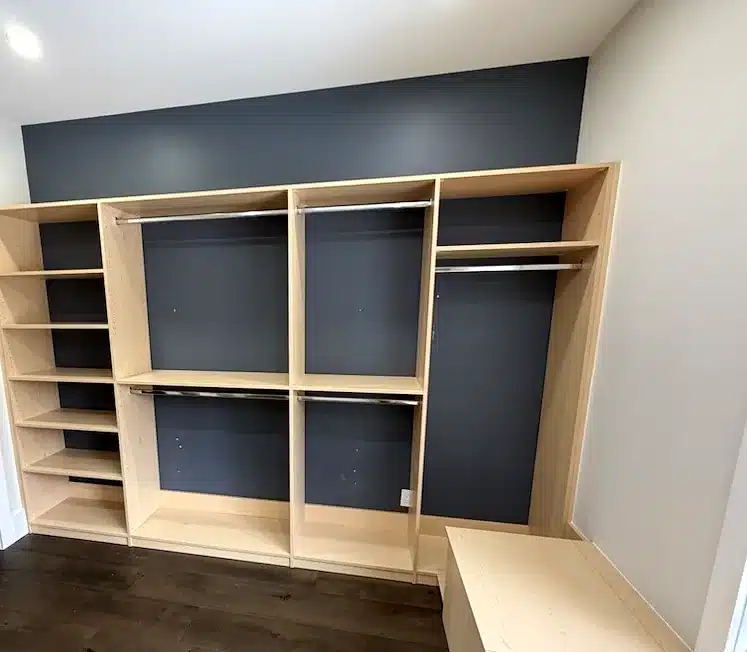
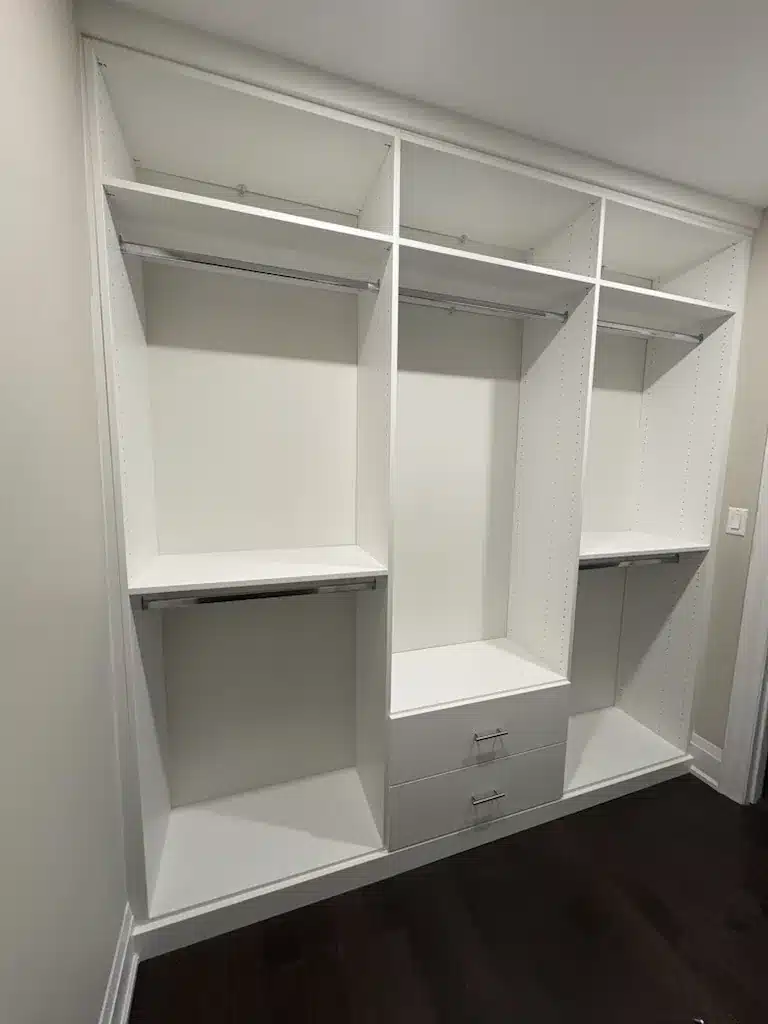
The rental version is plainer on purpose. Long hang, double hang, a run of adjustable shelves, and drawers when the room has nowhere to put a dresser. A neutral finish and ordinary proportions, with nothing in it that reads as somebody else’s taste, because a tenant at a showing is trying to picture their own things in that room.
The two things we don’t compromise on
There are two build decisions we hold to in a rental no matter what the budget looks like, and both exist so the closet can change without us.
Sections get built to matching widths wherever the wall allows it, so a shelf from one bay drops straight into any other bay. And every panel is drilled top to bottom on a repeating hole pattern, so shelves and rods move by hand.
Together those mean the closet is reconfigurable by a tenant on a Saturday afternoon, with no tools, no permission and no invoice. Somebody with a lot of dresses raises a rod and pulls a shelf. The next tenant, with mostly shirts and bins, puts it back. Neither of them contacts you.
The build spec underneath that, including floor-based construction, oval rods, steel shelf pins instead of plastic and undermount slides, is set out in full on our rental property storage page. The short version is that everything that fails in a rental is either a moving part or a fixing, so that’s where the money goes.
Changeover day
Here’s the comparison that decides it, because it’s the one an owner feels.
A wire kit from a big box store costs very little and does the job for one tenancy. At the first changeover you’re patching anchor holes, replacing a rod that’s taken a permanent bend, and discovering that the line was updated so the new shelf is an inch off the old one.
A closet built to the brief above turns over with a wipe-down and a decision about whether to move a couple of shelves. If something has actually broken, the Homeowners Lifetime Warranty is held by the owner of the property, so it doesn’t reset when a tenancy ends.
Multiply whichever version you pick by the number of turnovers you expect over ten years. That’s the whole business case, and it’s the reason the plainer closet is the one that pays.
Where we’d tell you not to bother
Fitted storage isn’t the right answer in every unit, and we’d rather say so at the measure than after.
If the place lets in a weekend at your asking price whatever the closets look like, storage isn’t what’s holding the unit back and the money is better spent somewhere else. If the closet opening is so small that doing it properly costs close to what moving a wall would cost, that’s worth knowing before you commit to either.
Where it earns its keep is the ordinary case: a unit competing against several near-identical ones at a similar rent, where storage is the visible difference between them.
Our designers travel across Ontario from the workshop at 73 Saunders Rd in Barrie, and the measure and the drawing are free either way. If you’ve got a unit turning over, rental property storage covers how we work with landlords and property managers, or call 705-315-9169 and we’ll come and look at it.